
Sports
AFCON to Be Held Every Four Years as CAF Announces Major Calendar Shift
The Africa Cup of Nations will move from a biennial to a four-year cycle after the 2028 edition, as CAF President Patrice Motsepe announces sweeping calendar reforms and the introduction of an African Nations League.


- The Africa Cup of Nations will move from a biennial to a four-year cycle after the 2028 edition, as CAF President Patrice Motsepe announces sweeping calendar reforms and the introduction of an African Nations League.

The Africa Cup of Nations (AFCON) will now be staged every four years, marking a major departure from its long-standing biennial format. The change will take effect after the 2028 edition, according to an announcement by Confederation of African Football (CAF) President, Patrice Motsepe.
Motsepe revealed the decision on Saturday in Rabat, Morocco, describing it as part of a broader restructuring aimed at easing pressure on Africa’s football calendar and aligning it better with global competitions.
Under the new arrangement, AFCON will be held in 2027 across Tanzania, Kenya, and Uganda, followed by another edition in 2028. Thereafter, the tournament will switch to a four-year cycle.

While AFCON’s two-year format has historically served as a major source of revenue for African football associations, Motsepe explained that the introduction of an annual African Nations League would help offset the financial impact of the change.
DON’T MISS: DR Congo Fires Back as FIFA Reviews Nigeria’s Petition
“After the FIFA Club World Cup in 2029, we will introduce the African Nations League, which will bring more prize money, more resources, and stronger competition,” Motsepe said.
AFCON, first held in 1957, has traditionally taken place every two years, but scheduling conflicts with European leagues and FIFA tournaments have increasingly posed challenges in recent years.
The new four-year cycle is expected to provide greater stability, enhance competition quality, and reduce congestion for players and national teams across the continent.






Ambrose Alli University Lecturer Dies in Hotel Room After Sexual Encounter With 21-Year-Old Woman
A senior lecturer at Ambrose Alli University, Ekpoma, Dr Matthew Uwuigbe, has died in a hotel room in Edo State...


Omotosho’s First Jurisdictional Failure — The Court Lacked Authority to Try Kanu
The Mazi Nnamdi Kanu Global Legal Consortium has alleged that the Federal High Court lacked jurisdiction to try Kanu on...


‘No Government Without a Country’: IPOB Rejects Self-Appointed Biafra Government Officers
Mazi Chris Nwaọgụ has reiterated IPOB’s demand for Nnamdi Kanu’s freedom and Biafra’s restoration, while calling for Kanu’s appeal to...


Sokoto Declaration: Emma Powerful Dismantles False Claims, Reaffirms Onyendu Mazi Nnamdi Okwu Kanu’s Referendum Position
Kanu’s camp has rejected claims that he did not approve or co-sign the Sokoto Declaration, while stressing that he does...


Kanu’s Unlawful Conviction, the Law That Was Already Dead, and the Shame That Is Waiting for Nigeria’s Judiciary
Christopher Chidera, Esq., has challenged the legal basis of Nnamdi Kanu’s conviction, arguing that the trial court relied on a...


Elochukwu Ohagi Describes Nnamdi Kanu as ‘Anointed Builder’ in Biafran Cenotaph Tribute
Elochukwu Ohagi has described Nnamdi Kanu as an “anointed builder” and “divine instrument” in the struggle for Biafran restoration, highlighting...


Delta Commissioner, Three Others Arrested Over Deputy Director’s Death
Five suspects are now in custody, while police have declared two others wanted as investigations into the ministry official’s death...
Kanu Family Fires Back: ‘No Statutory Transition Means No Valid Sentence’
The Okwu-Kanu Family has called for the immediate hearing of Nnamdi Kanu’s appeal, questioning the written law underpinning his conviction...
IPOB Accuses Nigerian Judiciary of ‘Judicial Banditry’ Over Nnamdi Kanu Conviction
IPOB has accused the Nigerian judiciary of violating constitutional provisions in Nnamdi Kanu’s conviction, questioning the legal basis of the...
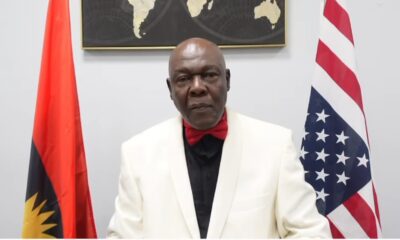

IPOB: Nnamdi Kanu Must Be Released Unconditionally, Appeal Must Be Listed — Chris Nwaọgụ
IPOB has renewed its demand for the immediate and unconditional release of Nnamdi Kanu, while calling for his pending appeal...