
Politics
‘Why Nigeria Will Never Achieve Credible Elections’: INEC Chair Amupitan Reveals
INEC Chairman Prof. Joash Amupitan says Nigeria’s elections will remain flawed unless citizens help remove the names of dead, relocated…

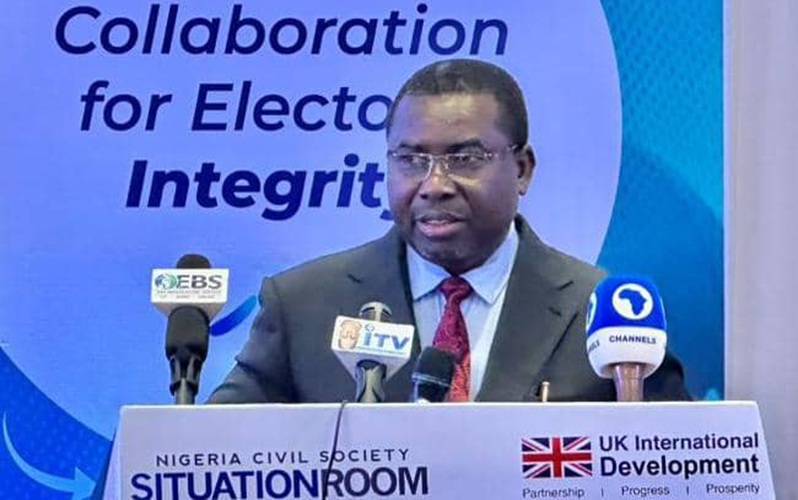
- INEC Chairman Prof. Joash Amupitan says Nigeria’s elections will remain flawed unless citizens help remove the names of dead, relocated, or ineligible individuals from the national voters’ register.

The Chairman of the Independent National Electoral Commission (INEC), Prof. Joash Amupitan, SAN, has warned that Nigeria cannot claim to have credible elections as long as the national voters’ register continues to hold the names of deceased citizens, people who have relocated, and other ineligible individuals.
Speaking at the Nigeria Civil Society Situation Room’s Stakeholders’ Forum in Abuja on Thursday, and represented by INEC’s Spokesperson and Head of Public Affairs, Amupitan appealed to civil society groups, traditional leaders, the media, and the general public to take the Claims and Objections window seriously when it opens on December 15 as part of the Continuous Voter Registration (CVR) exercise. He described the process as essential to cleansing the register and restoring public trust.
He recalled discovering during preparations for the Anambra governorship election that the name of a prominent leader who died in 2020 still appeared on the register, describing such lapses as damaging to Nigeria’s democracy. He stressed that many Nigerians fail to examine the displayed register, allowing errors and duplicate entries to go unnoticed.
According to the Commission, the first phase of the CVR exercise, which ran from August 18 to December 10, recorded 2,685,725 new registrations—1,576,137 online and 1,109,588 through physical capture. Amupitan commended the growing civic awareness, with strong participation reported in Osun, Kano, Sokoto, Imo, Borno, and Lagos States.
He announced that Phase 2 of the CVR would begin on January 5, 2026, with centres moved closer to communities to address accessibility challenges that hindered turnout in several areas. He said assessments showed that distance was a major barrier and that relocating centres would make registration easier for more Nigerians.
Amupitan also highlighted preparations for the upcoming FCT Area Council elections set for February 21, 2026, stressing that INEC remains fully responsible for conducting the polls. He assured that all relevant information and timelines have already been published and that discussions on logistics and security are ongoing to ensure a transparent process.

He touched on broader issues affecting elections, including insecurity, political culture, technology, and legal compliance. While acknowledging the challenges of insecurity, he urged calm and collaboration among stakeholders. He argued that Nigeria must develop a democratic culture suited to its realities, rather than copying foreign practices.
DON’T MISS: ‘Send Your Son, Not the Military to Stop Benin Coup’, Soyinka Berates Tinubu Over Seyi’s Heavy Security
On electoral technology, he said BVAS has effectively blocked over-voting while IReV has improved transparency in result collation, though connectivity issues in some polling units still pose challenges. Citing lessons from the Anambra election, he noted that extending PVC collection increased turnout significantly, showing the impact of data-driven decision-making.
He also condemned vote buying, describing it as a major threat to credible elections, and noted that law enforcement agencies have been involved to investigate reported cases.
Prof. Amupitan concluded by urging Nigerians to take the upcoming Claims and Objections period seriously, emphasising that INEC cannot purify the voters’ register alone. He called for collective responsibility in strengthening the foundation of Nigeria’s electoral process and building the democracy citizens aspire to.






What Every First-Time Home Buyer in Nigeria Should Know
Every home buyer should understand that buying a home for the first time in Nigeria comes with legal, financial, and...

FG Bans Electricity Meter Charges, Threatens Prosecution for Extortion
The Federal Government has prohibited electricity distribution companies and installers from collecting money for meters...

FULL LIST: NJC Sends 14 Nominees to Tinubu for Appointment as Federal High Court Judges
The National Judicial Council has forwarded the names of 14 candidates to President Bola Tinubu for appointment as judges of...


Most Profitable Side Hustles for Students in Nigeria
Side hustles have become essential for students in Nigeria seeking extra income and financial independence.


LIRS Warns Employers as January 31 Tax Deadline Approaches
The Lagos State Internal Revenue Service has cautioned employers across the state to meet the January 31 deadline for annual...

UN Warns 35 Million Nigerians Face Acute Hunger in 2026
The United Nations says nearly 35 million Nigerians could face acute food insecurity and hunger during the 2026 lean season,...


Step-by-Step Guide: How to Apply for Federal Government Loans in Nigeria in 2026
This 2026 guide explains official FG loan programs, eligibility requirements, and step-by-step instructions on how to apply successfully.


FG Seeks Review of Workers’ Compensation, Says Current Payments No Longer Reflect Reality
The Federal Government has called for an urgent review of workers’ compensation laws, warning that existing payments are inadequate to...

FG Opens Applications for 2026 PTDF Overseas Scholarships for UK, Germany, France, Malaysia – Apply
The Federal Government has opened applications for the 2026 Petroleum Technology Development Fund (PTDF) Overseas Scholarship Scheme...

ADC Will Bleed After Convention as Atiku Clinches Presidential Ticket — Baba-Ahmed Warns
Former Northern Elders Forum spokesperson, Hakeem Baba-Ahmed, has warned that the African Democratic Congress (ADC) may face internal crisis and...