
Politics
BREAKING: Not Health, Real Reason Badaru Resigns as Defence Minister
Badaru Abubakar’s resignation as Minister of Defence was officially blamed on health challenges.

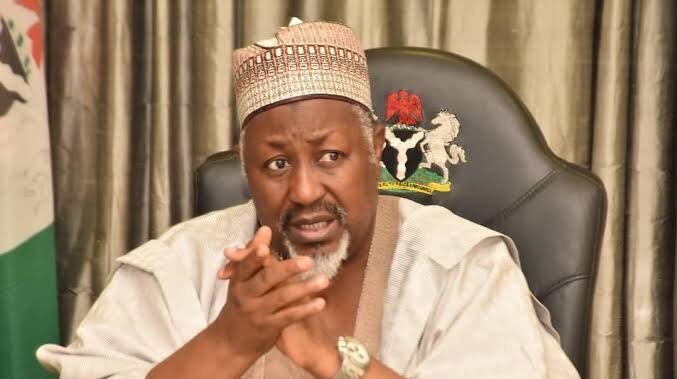
- Badaru Abubakar’s resignation as Minister of Defence was officially blamed on health challenges.

New details have emerged over the abrupt resignation of former Minister of Defence, Badaru Abubakar, after only two years in office.
Although the Presidency announced that he stepped down due to poor health, multiple sources within the ministry say his exit was driven by a sustained internal power struggle with the Minister of State for Defence, Bello Matawalle.
Badaru resigned on Monday and was immediately replaced by former Chief of Defence Staff, General Christopher Musa (retd.), who was sworn in by President Bola Tinubu.
The official statement from the Presidency described the move as a medical decision. But those familiar with developments insist that Badaru had been under pressure for months as insecurity worsened across the country, especially after a fresh wave of school kidnappings triggered public outrage and forced the government to declare a security emergency.
Badaru’s challenges began long before that. He returned to the federal executive council in 2023 after serving two terms as governor of Jigawa State and was expected to stabilise defence policy and coordinate operations against bandits and insurgents. On the same day he was appointed, Tinubu named Bello Matawalle as Minister of State for Defence, with instructions to work closely with Badaru.
That relationship never worked.
Officials in the ministry said both men displayed cordiality in public, but behind the scenes, they barely cooperated. Their strained relationship affected communication, media coordination and key decisions. One senior official familiar with the situation described their working environment as “cold, tense and unproductive,” adding that the friction was well known within the ministry.
“The relationship between the two of them was never warm,” the source said. “They worked together, but there was no real teamwork. They just tolerated each other in front of cameras.”
As insecurity grew worse — with bandit attacks, terror activities and mass abductions of schoolchildren — criticism intensified. Several analysts and groups argued that the defence ministry was not delivering results, and pressure mounted for Badaru to step aside.
International attention made matters worse. When the United States again placed Nigeria on a watchlist over concerns about violence and religious killings, the defence ministry came under renewed scrutiny.
Meanwhile, Matawalle was perceived as gaining influence. Officials said he enjoyed strong access to the Presidency and ruling party leaders, especially from the North-West, where he remains a significant political figure. Some insiders believe his political standing made him more valuable for the government ahead of the 2027 elections.
“Party leaders see Matawalle as an asset,” one official said. “He has the grassroots power. That gives him cover. Badaru did not have that. Politically, he was the weaker one.”
By the last week of November, criticism had peaked. Badaru resigned on December 1, clearing the way for General Musa to take over.
Matawalle, despite the crisis, has not been removed, though calls for his resignation have grown since Badaru stepped down. Activists, civil society organisations and some political opponents argue that he has not been effective in improving security. He has consistently rejected allegations linking him to bandit groups, including accusations made by the Zamfara State government last year.

Still, senior figures within the defence ministry believe Matawalle will likely remain in office. They point to his recent involvement in the rescue of abducted students in Kebbi State, which they say demonstrates his usefulness in the security architecture.
When General Musa assumed duty on Friday, Matawalle was noticeably absent. No official explanation was given.
DON’T MISS: ‘Trump is On Our Neck’: Akpabio Rejects Calls for Christopher Musa to Take a Bow
Musa immediately announced that his first task would be a comprehensive review of all theatre commands and operational structures. He stressed that welfare would be treated as core strategy, not routine administration. According to him, morale among troops must be restored through timely allowances, proper equipment, decent accommodation and care for injured personnel and families of fallen soldiers.
He emphasised that security agencies must operate as a unified system, not as separate entities, adding that Nigeria could no longer afford fragmented command structures.
“The threats we face are complex,” he said, “but our spirit is stronger. No single service can succeed alone. We must work as one.”
Musa promised strict discipline, zero tolerance for corruption and a renewed focus on technology, intelligence and cooperation with allies.
He concluded with a pledge that reflected the widespread demand for results:
“The Nigerian people are looking to us for peace, security and stability. Children must return to school. Farmers must return to their farms. We will deliver.”






Bus Driver Returns Over N400,000 Forgotten by Passenger in Abia
An Abia commercial bus driver, Onyekachi Ikpendu, has been praised after returning over N400,000 and personal belongings accidentally left behind...


FG Begins N18bn Payment to 2,700 Ex-Nigeria Airways Workers After 20 Years
The Federal Government has commenced the payment of N18bn in outstanding severance benefits to 2,700 former Nigeria Airways workers...


Nigerians to Get Free Data Daily for Online Learning
The Nigerian Communications Commission has launched a zero-rated data initiative that will provide eligible users with up to 100MB of...


BREAKING: Peter Obi Breaks Silence on Stepping Down for Atiku
Peter Obi says any alliance with Atiku Abubakar must be negotiated by their political parties, while outlining his positions on...

BREAKING: National Assembly Suspends South Africa Trips, Orders Legislative Boycott
The National Assembly has suspended official visits to South Africa and participation in its legislative events over reported xenophobic attacks...

How Justice Omotosho Turned Criminal Law Upside Down to Convict Nnamdi Kanu
According to Chidera, Section 36(12) of the Nigerian Constitution requires a criminal offence to be defined and its punishment prescribed...


IPOB: The Boycott Is Not a Threat — List Kanu’s Appeal or Lose Biafraland’s Vote
The Indigenous People of Biafra (IPOB) has threatened a total boycott of upcoming elections across Biafraland and other areas if...

Kanu Fires Lawyer for ‘Gross Incompetence’ — IPOB Warns Media: Stop Calling Him Our Counsel
The Indigenous People of Biafra (IPOB) has said lawyer Ifeanyi Ejiofor is no longer a member of its legal team,...

How Nigerian Media Buried the Constitutional Time Bomb in Kanu’s Conviction
Legal practitioner Christopher Chidera, Esq., has launched a sharp criticism against major Nigerian media outlet....
IPOB: List Kanu’s Appeal in 14 Days or We Boycott 2027 General Elections Across Biafraland
The Indigenous People of Biafra (IPOB) has given the Federal Government of Nigeria a 14-day ultimatum to list and hear...