
Politics
DSS Officers Seek VIP Security Roles After Tinubu Withdraws Police Escorts
Following President Tinubu’s withdrawal of police escorts, some DSS officers are reportedly lobbying to serve as personal security details for VIPs…

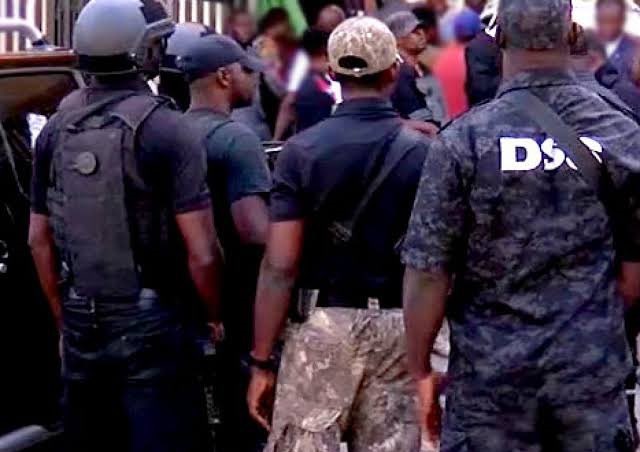
- Following President Tinubu’s withdrawal of police escorts, some DSS officers are reportedly lobbying to serve as personal security details for VIPs, even as the agency maintains strict rules for such deployments.

Operatives of the Department of State Services (DSS) have reportedly begun reaching out to politicians and other influential Nigerians, offering themselves as alternative personal security details following President Bola Ahmed Tinubu’s directive withdrawing police escorts from VIPs.
Recall that on November 24, President Tinubu ordered the withdrawal of all police officers attached to politicians and other VIPs as part of efforts to tackle worsening insecurity nationwide, including rising cases of kidnapping in Kwara, Kebbi, Niger and other northern states.
In a statement issued at the time, the President’s Special Adviser on Information and Strategy, Bayo Onanuga, said the President directed that armed personnel of the Nigeria Security and Civil Defence Corps (NSCDC) should take over VIP protection duties previously handled by the police.
Acting on the directive, the Inspector-General of Police, Kayode Egbetokun, announced three days later that a total of 11,566 police personnel had been withdrawn from VIP protection and redeployed to core policing duties.
While several affected VIPs have since approached the NSCDC to request its officers as escorts, reports indicate that some DSS personnel have also been approaching highly placed individuals, urging them to request their deployment as new security details.
One such VIP, a top executive of a federal government revenue-generating agency in Lagos, said DSS officers who had long been familiar with him saw the withdrawal of police escorts as an opportunity to secure what he described as a “juicy” posting.
“The policemen attached to me were withdrawn last week, and I was considering getting men of the Nigeria Security and Civil Defence Corps,” he said. “But these DSS officers have been coming around and presenting themselves as alternatives. They have visited twice, asking me to speak with their state director so they can be deployed here.”
Asked whether he would consider the request, the official expressed reservations, questioning the manpower strength of the DSS.
Similarly, an aide to a businessman and religious leader in Osogbo, Osun State, disclosed that some DSS officers had approached the man’s children to express interest in replacing the withdrawn police escorts. The aide, who spoke on condition of anonymity, said the officers asked the children to persuade their father to influence their deployment.

However, a senior DSS officer familiar with the situation downplayed the development, saying those seeking such postings were mostly “lower cadre” personnel. He explained that the service operates under strict rules governing VIP attachments, noting that the current Director-General, Adeola Ajayi, has eliminated arbitrary deployments.
According to him, officers above Level 13 are no longer deployed to VIP duties except in special cases involving governors or the State House in Abuja. “Those seeking attachment to VIPs now may just be engaging in a wild goose chase,” he said.
DON’T MISS: Peter Obi Reacts to Seizure of Nigerian-Owned Supertanker by US Authorities
Another DSS officer acknowledged that protecting VIPs falls within the agency’s statutory responsibilities but warned colleagues against being overly eager for such postings. He stressed that any deployment would strictly follow established protocols.
“There may be some truth that a few officers are lobbying for VIP assignments,” he said. “But deployment is not automatic. Those eyeing so-called ‘juicy’ postings should understand that procedures must be followed.”
The DSS, also known as the State Security Service (SSS), was established in 1989 and is Nigeria’s primary domestic intelligence agency, responsible for counterintelligence, counterterrorism, protection of top government officials, and safeguarding national stability.






‘You Don’t Have to Get Married or Have Kids’ — Actress Tayo Adeniyi Tells Women
Nollywood actress Tayo Adeniyi has urged women not to base their happiness or self-worth on marriage and motherhood, saying they...


VIDEO: Residents Flee in Panic as Multiple Explosions Rock Abuja Near Filling Station
Residents fled in panic after multiple explosions were reported near Shafa Filling Station in Abuja's Apo Bridge area, with emergency...

US Visa Wait Time In Lagos And Abuja: How To Check Available Appointment Slots
US visa wait time in Lagos and Abuja explained: latest official appointment estimates, how Nigerians can check available slots, reschedule...


Army Arrests Two Soldiers Seen Acting as ‘Bouncers’ at Peller, Jarvis’ Wedding
The Nigerian Army has arrested two serving soldiers over their alleged involvement in an unauthorised deployment at the wedding of...


Air Peace Announces Flight Disruptions After FAAN Equipment Failure in Abuja
Air Peace has announced disruptions to some of its flight operations after a baggage screening machine at FAAN's domestic terminal...
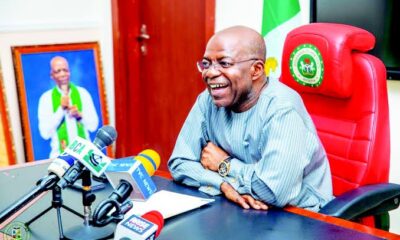

Orji Kalu Backs Alex Otti for Second Term, Predicts Re-Election
Senator Orji Uzor Kalu has predicted that Abia State Governor Alex Otti will secure a second term in office, while...


Tinubu Has ‘No Competition’, Opposition Too Weak — Orji Kalu
Senator Orji Uzor Kalu says President Bola Tinubu remains the favourite to win the 2027 presidential election, insisting he has...


PFIPC DG Adeyemi Rejects Secret House Probe, Demands Public Hearing
Detained PFIPC DG Adeniyi Adeyemi has rejected plans by the House of Representatives to question him behind closed doors.


‘Why We Froze Osun Govt Accounts’ — EFCC
The EFCC says it froze Osun State Government accounts to stop the alleged diversion of public funds, revealing it is...


Three Children Found Dead in Anambra Native Doctor ‘Ezenwanyi’s’ House
Police have launched an investigation after three children were found dead and a fourth rescued in critical condition at the...