
Politics
Judicial Fumble Reloaded: How a Nigerian Court Twisted Repealed Law Jurisprudence to Jail Nnamdi Kanu
A Federal High Court judgment delivered in March 2025 has ignited fierce legal debate after critics alleged that Justice J.K. Omotosho convicted Nnamdi Kanu under a terrorism law repealed years earlier…

- A Federal High Court judgment delivered in March 2025 has ignited fierce legal debate after critics alleged that Justice J.K. Omotosho convicted Nnamdi Kanu under a terrorism law repealed years earlier, raising troubling questions about judicial reasoning, statutory repeal, and the future of the rule of law in Nigeria.

On March 21, 2025, the Federal High Court in Abuja delivered judgment in FRN v. Nnamdi Kanu (FHC/ABJ/CR/383/15)—a ruling that has since been described by legal analysts as a textbook example of judicial contradiction. Certified True Copies (CTCs) of the proceedings and judgment suggest that the court convicted Kanu under a repealed statute by relying on a controversial interpretation of Section 98(3) of the Terrorism (Prevention and Prohibition) Act, 2022 (TPPA).
The documents, supported by multiple exhibits, present a stark narrative: while the law is clear and the record unambiguous, the judgment appears to chart a different course.
1. Routine Courtroom Procedure, Hidden Fatal Error
Court records show that Kanu was re-arraigned, with the original 15-count charge reduced to seven. The registrar read the charges, Kanu sought clarification on one count, and pleaded “not guilty” to all. On the surface, the process followed standard criminal procedure.
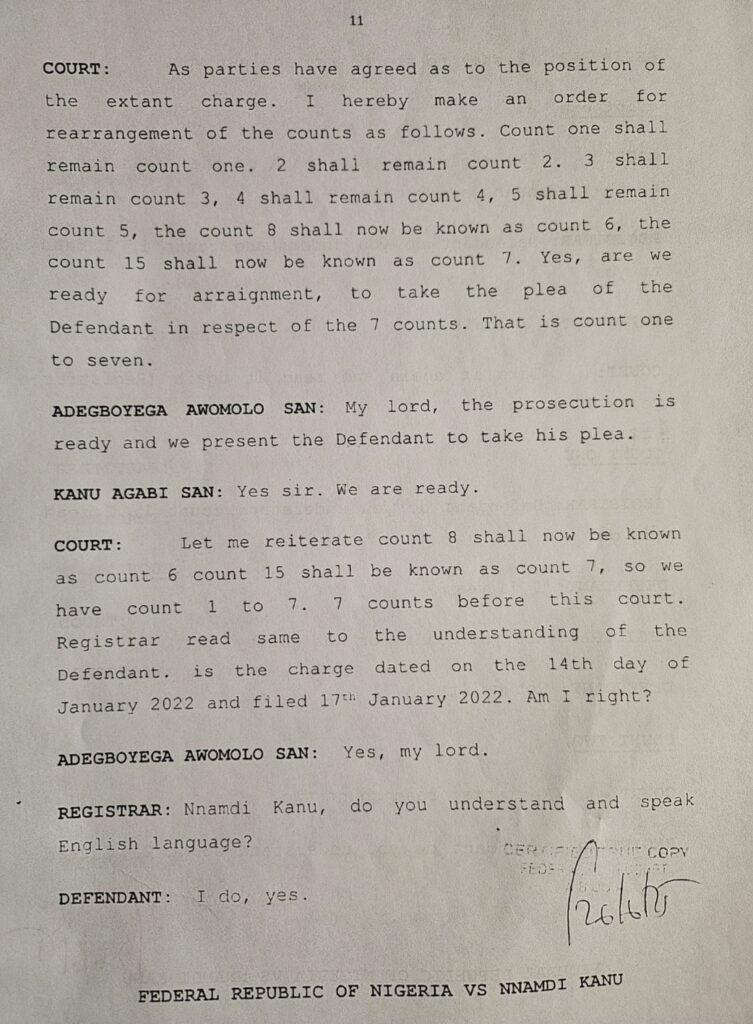
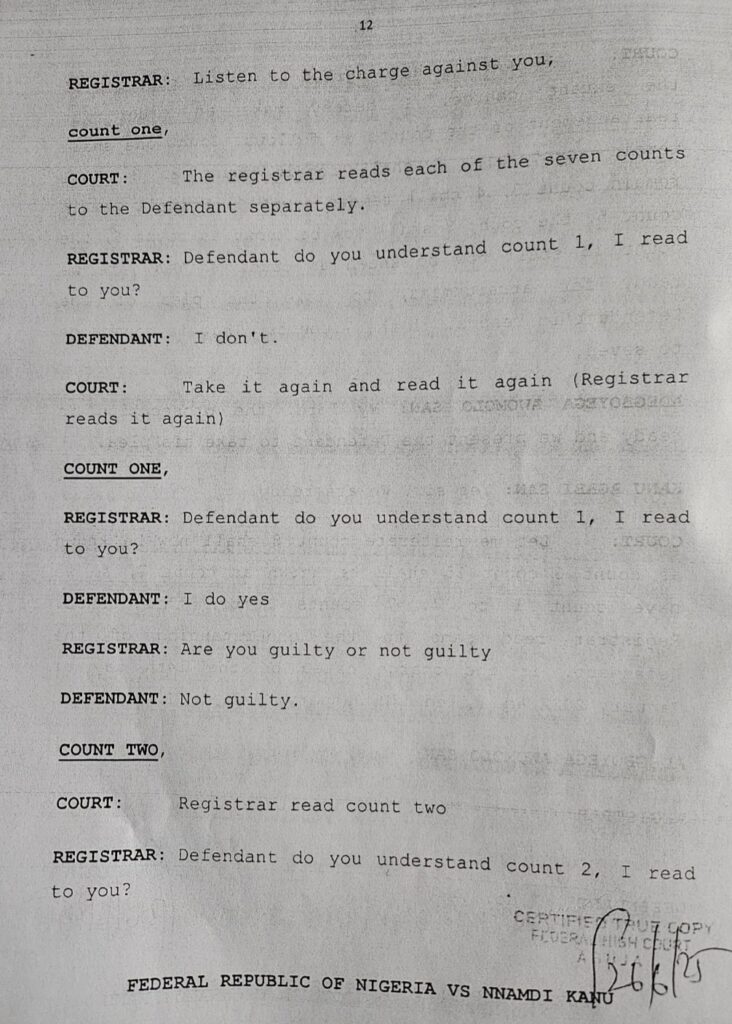
However, the arraignment and trial were conducted under the Terrorism (Prevention) Act (TPAA)—a law repealed by the National Assembly in 2022. Critics argue that this single fact fatally undermined the entire proceeding.
2. A Rule the Court Acknowledged—Then Ignored
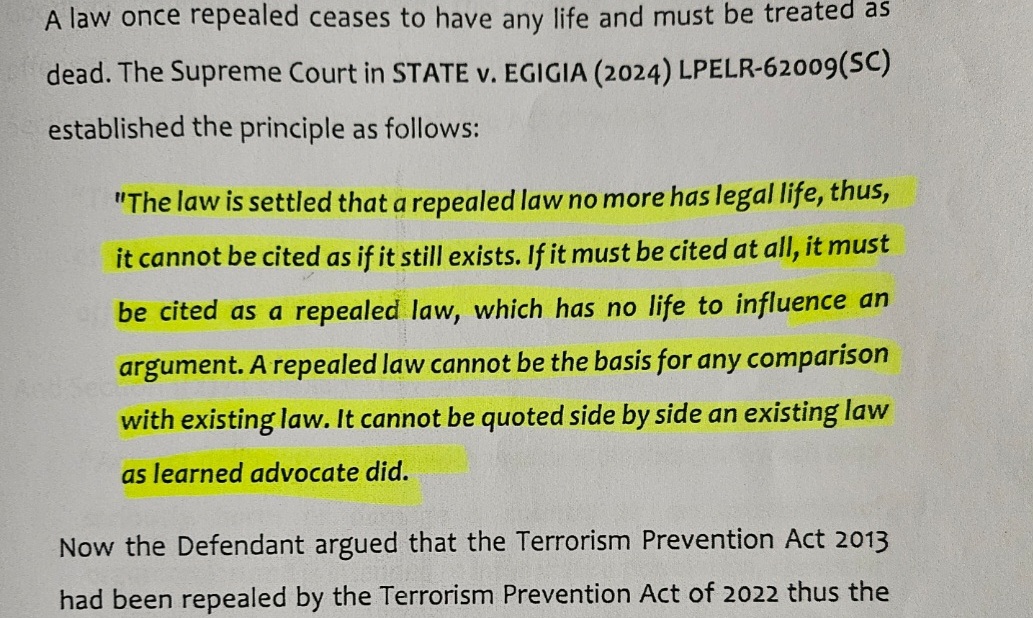
Ironically, Justice Omotosho cited established authorities such as Ogundimu, Daniel, and State v. Egigia, all of which affirm a settled legal principle: a person cannot be tried or convicted under a repealed law. The judgment even underlined the phrase describing such proceedings as “a nullity.”
Yet, despite acknowledging this doctrine, the court proceeded to do exactly what the authorities forbid.
3. The Two Pillars of Criminal Jurisdiction
Legal commentators emphasize that criminal jurisdiction rests on two pillars:
- the law must have existed when the alleged offence occurred, and
- the law must still be in force at the time of trial and conviction.
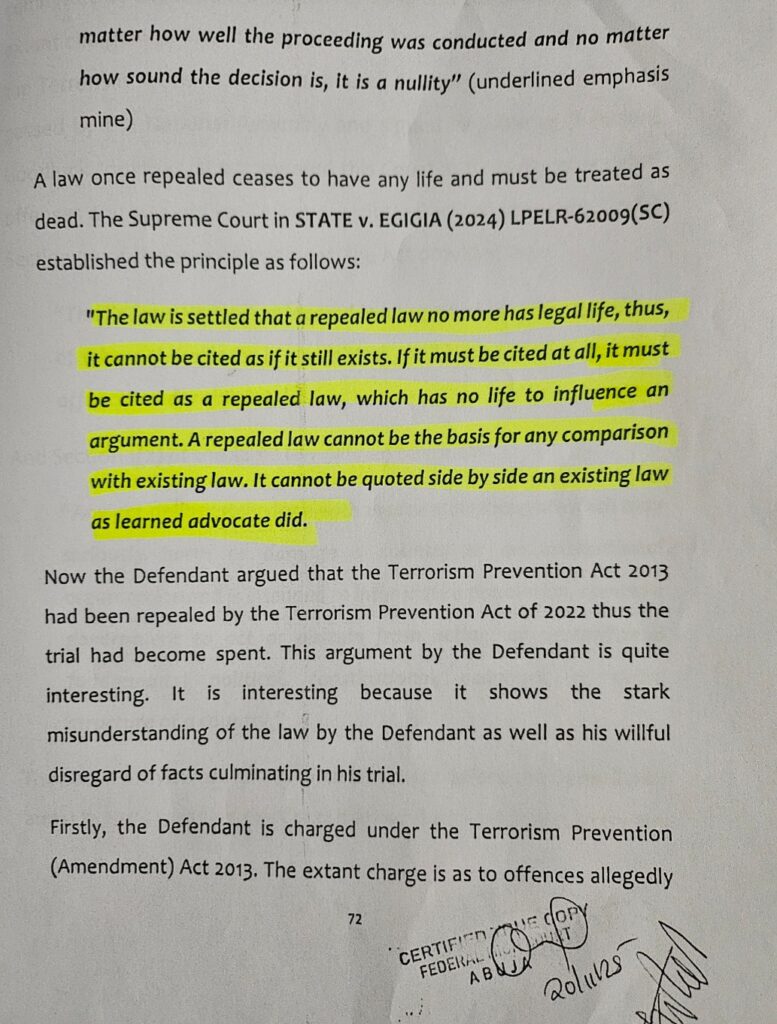
While the TPAA was in force when the alleged acts occurred, it had been repealed long before the 2025 trial. With the second pillar gone, critics argue that jurisdiction collapsed entirely.
4. The Section 98(3) Controversy
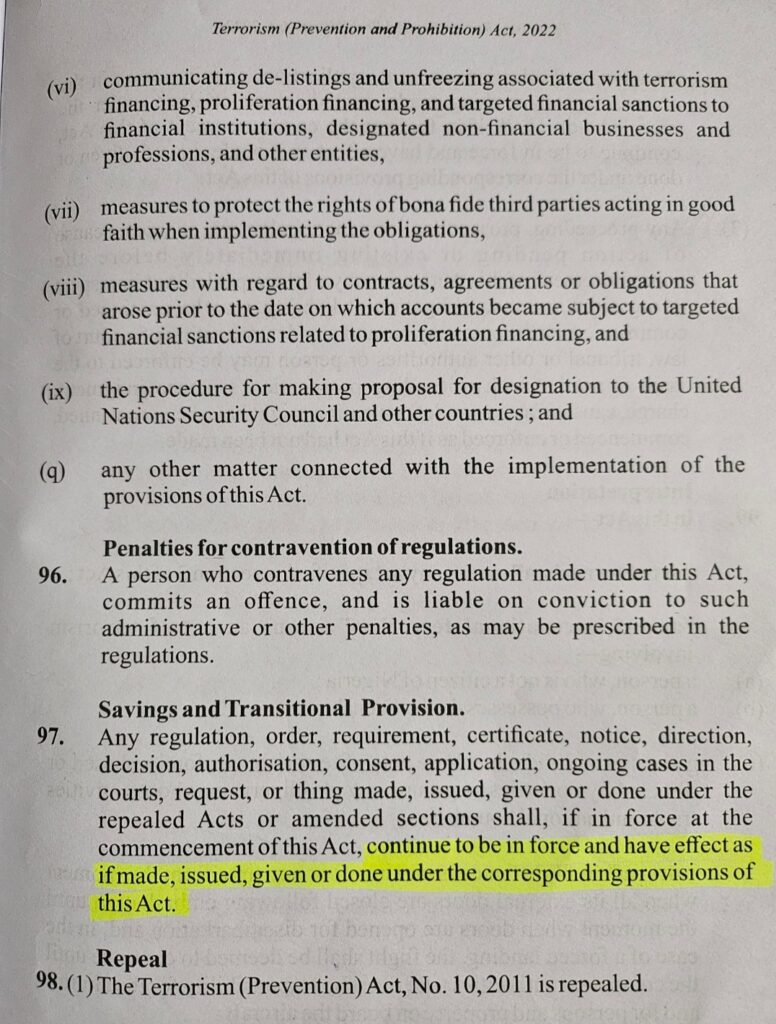
At the heart of the dispute is Section 98(3) of the TPPA, which preserves certain liabilities incurred under the repealed law. Justice Omotosho reportedly treated this provision as authority to proceed as if the TPPA did not exist.

Legal analysts counter that this interpretation is untenable. Section 98(3), they argue, preserves liabilities—not repealed statutes—and Section 97 of the same Act expressly provides the mechanism for transitioning such liabilities under the new law.
5. Judicial Notice Avoided
The judgment has also been criticised for allegedly sidestepping Section 122 of the Evidence Act, which mandates courts to take judicial notice of existing laws. Observers claim the court adopted the phrase “assume without conceding” to avoid acknowledging the legal consequences of the repeal.
DON’T MISS: Delta Governor Oborevwori Spotted Serving as Usher at Shiloh 2025 (Video)
6. Why Savings Clauses Cannot Revive Dead Laws
Experts note that savings clauses preserve ongoing administrative acts, not substantive criminal statutes. There is, they argue, no Nigerian or Commonwealth precedent where a conviction under a repealed criminal law was upheld solely on the basis of a savings clause.
7. A Dangerous Precedent
If allowed to stand, critics warn, the judgment could open the door to prosecutions under laws Parliament has already abolished, eroding legal certainty and constitutional safeguards.
Conclusion: A Test for the Appellate Courts
The controversy has now shifted to the appellate courts. Analysts say the case is no longer just about Nnamdi Kanu, but about whether repeal truly means repeal, and whether courts are bound by legislative authority.
For many, the March 21 judgment represents not just a legal error, but a profound challenge to the rule of law—one that only appellate intervention can resolve.
SOURCE: Kalu Legal






Champions League Quarter-Finals Confirmed, See Fixtures
The UEFA Champions League quarter-final lineup is set, with blockbuster clashes including PSG vs Liverpool and Real Madrid vs Bayern...


‘We Miss Aregbesola’: Nigerian Youths Slam Tunji-Ojo Over Public Holiday Declaration (Video)
Nigerian youths have criticised Interior Minister Olubunmi Tunji-Ojo over the choice of Thursday and Friday as Eid-el-Fitr holidays.


Israel Kills of Iran’s Intelligence Minister Esmail Khatib
Israel says it has killed Iran’s Intelligence Minister Esmail Khatib, though Iranian authorities have yet to confirm the claim amid...


Rival Fans Hold Mock Candlelight Procession for Chelsea After 8–2 Loss to PSG in Champions League (Video)
A viral video shows rival fans staging a mock candlelight procession for Chelsea after their 8–2 aggregate loss to Paris...


74-Year-Old Woman Gifts Governor Soludo Live Fowl at Inauguration (Video)
A 74-year-old woman drew attention at Governor Chukwuma Soludo’s inauguration in Awka after presenting a live fowl in appreciation of...

‘This War Will Hit Everyone No Matter Race, Religion’ – Iran Warns
Iran’s Foreign Minister Abbas Araghchi has warned that the ongoing war will impact people worldwide, urging more international voices to...


Court Declares It Legal to Record Police Officers on Duty
A Federal High Court in Warri has affirmed the right of Nigerians to record police officers in public.


BREAKING: FG Declares Two-Day Public Holiday
The Federal Government has announced two-day public holiday.

IPOB Accuses Nigerian Govt, Army of Plot to Demonise Group and Justify Attacks in South-East
The Indigenous People of Biafra has accused the Nigerian government and the military of fabricating insecurity in the South-East.


List of Approved 114 Universities to Run Law Programmes in Nigeria (Full List)
The Council of Legal Education has released the list of 114 universities authorised to run Bachelor of Laws (LL.B) programmes...