
Politics
Senate Meets Tuesday as ₦1.3bn Fake Agency Budget Scandal Deepens
The Senate is expected to address the controversial N1.3 billion allocation to the PFIPC amid revelations that a forged appointment letter allegedly gave the agency government legitimacy.

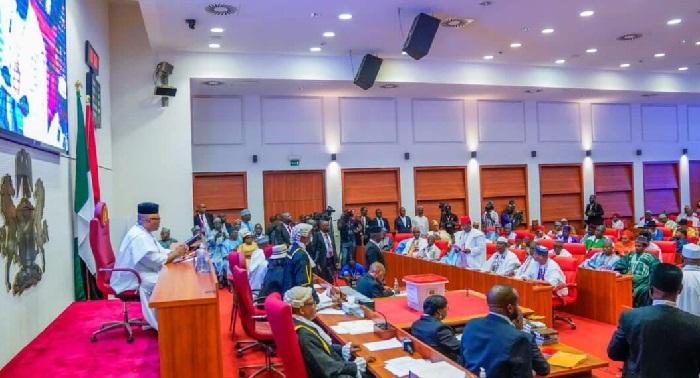
- The Senate is expected to address the controversial N1.3 billion allocation to the PFIPC amid revelations that a forged appointment letter allegedly gave the agency government legitimacy.

The Senate is expected to address the growing controversy surrounding the ₦1.3 billion allocation to the controversial Presidential Foreign Intervention Promotion Council (PFIPC) when plenary resumes on Tuesday.
The development comes amid fresh revelations that a forged appointment letter, bearing a falsified signature of the President’s Chief of Staff, Femi Gbajabiamila, allegedly enabled the council to operate as a legitimate government agency for more than a year.
According to multiple Presidency and civil service sources, the forged document was accepted at the Civil Service Headquarters without proper verification, allowing Prince Adeniyi Adeyemi Mathew to secure office space at the Federal Secretariat Complex in Abuja.
The sources said the failure of several government institutions to conduct due diligence created loopholes that allowed the alleged fraud to spread across ministries, diplomatic missions, the National Assembly and private organisations.
A National Assembly source disclosed that the controversial ₦1.3 billion allocation was approved without Adeyemi or any representative of the council appearing before the Senate Committee on Establishment and Public Service to defend the budget.
“It was not brought in as a stand-alone item. It was done collectively with others that came in directly from the Presidency. So there was no defence or oversight.
“But I understand the Senate leadership will address the controversy on Tuesday to douse the growing tension and alleged complicity by any of its presiding officers,” the source said.
A Presidency official explained that the alleged fraud began with a forged appointment letter that bypassed established government procedures.
“The mistake came from several areas, the House of Representatives, the Head of Service, the Budget Office. Most of them did not do due diligence. But you see where you can’t readily blame all of them is what we call grundnorm. There is a foundation. The appointment letter was fake. It was invalid.”
The source stressed that under Nigeria’s constitutional process, appointments to agencies under the Presidency can only be approved by the President and formalised through the Secretary to the Government of the Federation (SGF), not by the Chief of Staff.
Another senior civil servant alleged that Adeyemi exploited that gap by presenting the forged appointment letter to obtain office space at the Federal Secretariat.
“Where Adeniyi scammed everyone was that he forged a letter with the signature of the Chief of Staff… It was not Gbajabiamila’s signature. The Chief of Staff cannot make such an appointment.”
The official added that once office space was allocated, the council appeared legitimate.
“Once you have an office there, it confers a very high level of legitimacy on you. He had a letterhead and even a website. Once he established that office at the Federal Secretariat, every other thing followed.”
The Presidency also revealed that the alleged scheme was first uncovered after officials of the Nigerian Investment Promotion Commission (NIPC) raised concerns that the council was encroaching on its statutory responsibilities.
“The Chief of Staff swore that he has never met the man and doesn’t even know him… he was the one who alerted the DSS,” another Presidency source said.
Meanwhile, the controversy has triggered widespread reactions from civil society organisations and opposition figures.
The Socio-Economic Rights and Accountability Project (SERAP) has demanded the release of all documents relating to the controversial budget allocation.
“Nigerians have a right to know whether public funds were appropriated for an entity that was not lawfully established and, if so, how this occurred. Nobody has a more sacred obligation to obey the law than those who make the law,” the organisation stated.
Former Vice President Atiku Abubakar also criticised the Federal Government over the controversy, saying:
“The issue is no longer one scandal or another. The issue is the pattern. And when scandals become a pattern of governance, the inevitable conclusion is this: you are no longer managing scandals; you have become the scandal itself.”
Adeyemi is expected to appear before the Federal High Court in Abuja on July 27, 2026, alongside two accomplices who remain at large, while the Senate is expected to clarify how the controversial allocation found its way into the 2026 Appropriation Act.






Omotosho’s First Jurisdictional Failure — The Court Lacked Authority to Try Kanu
The Mazi Nnamdi Kanu Global Legal Consortium has alleged that the Federal High Court lacked jurisdiction to try Kanu on...


‘No Government Without a Country’: IPOB Rejects Self-Appointed Biafra Government Officers
Mazi Chris Nwaọgụ has reiterated IPOB’s demand for Nnamdi Kanu’s freedom and Biafra’s restoration, while calling for Kanu’s appeal to...

Sokoto Declaration: Emma Powerful Dismantles False Claims, Reaffirms Onyendu Mazi Nnamdi Okwu Kanu’s Referendum Position
Kanu’s camp has rejected claims that he did not approve or co-sign the Sokoto Declaration, while stressing that he does...


Kanu’s Unlawful Conviction, the Law That Was Already Dead, and the Shame That Is Waiting for Nigeria’s Judiciary
Christopher Chidera, Esq., has challenged the legal basis of Nnamdi Kanu’s conviction, arguing that the trial court relied on a...


Elochukwu Ohagi Describes Nnamdi Kanu as ‘Anointed Builder’ in Biafran Cenotaph Tribute
Elochukwu Ohagi has described Nnamdi Kanu as an “anointed builder” and “divine instrument” in the struggle for Biafran restoration, highlighting...


Delta Commissioner, Three Others Arrested Over Deputy Director’s Death
Five suspects are now in custody, while police have declared two others wanted as investigations into the ministry official’s death...
Kanu Family Fires Back: ‘No Statutory Transition Means No Valid Sentence’
The Okwu-Kanu Family has called for the immediate hearing of Nnamdi Kanu’s appeal, questioning the written law underpinning his conviction...
IPOB Accuses Nigerian Judiciary of ‘Judicial Banditry’ Over Nnamdi Kanu Conviction
IPOB has accused the Nigerian judiciary of violating constitutional provisions in Nnamdi Kanu’s conviction, questioning the legal basis of the...

IPOB: Nnamdi Kanu Must Be Released Unconditionally, Appeal Must Be Listed — Chris Nwaọgụ
IPOB has renewed its demand for the immediate and unconditional release of Nnamdi Kanu, while calling for his pending appeal...

‘Show Me the Law’ Is Not a Joke — It Is Section 36, Section 122, and the Supreme Court, Spoken from the Dock
Ifedi argues that Kanu’s conviction relied on a repealed terrorism law, raising fundamental constitutional questions about its validity.