
Business
Nigeria’s Foreign Reserves Hit 17-Year High, Cross $51 Billion
Nigeria’s external reserves have climbed to $51.04 billion, their highest level in about 17 years, driven by stronger foreign exchange inflows…


- Nigeria’s external reserves have climbed to $51.04 billion, their highest level in about 17 years, driven by stronger foreign exchange inflows, improved liquidity, and ongoing economic reforms.

Nigeria’s external reserves have risen to $51.04 billion, reaching their highest level in nearly 17 years, according to data from the Central Bank of Nigeria (CBN).
The latest figure, recorded on June 18, 2026, marks the strongest reserve position since January 2009, when the country’s reserves stood at approximately $51.07 billion.
Data from the apex bank shows that the reserves increased by 3.76 percent, or $1.85 billion, from $49.18 billion on April 1, 2026, to $51.04 billion in mid-June, reflecting stronger foreign exchange inflows and improved liquidity conditions in Nigeria’s external sector.
Nigeria first crossed the $50 billion mark on March 10, 2026, when reserves reached $50.01 billion, before rising to $50.11 billion on June 5 and eventually surpassing $51 billion.
The increase followed the CBN’s review of payment methods for International Money Transfer Operators (IMTOs). In March, the bank directed all IMTOs to open naira settlement accounts and route remittance transactions through them, ending decades of dollar cash payments to recipients of diaspora remittances.
The CBN said the directive forms part of broader efforts to strengthen Nigeria’s remittance framework under the revised guidelines for international money transfer services introduced in January 2024.
Reacting to the development, the Chief Executive Officer of the Centre for the Promotion of Private Enterprise (CPPE), Dr. Muda Yusuf, described the reserve growth as a positive sign that economic reforms are beginning to yield results.
DON’T MISS: IGP Disu Replaces Police Spokesman Three Months After Appointment, Names New FPRO
However, he stressed the need for Nigeria to diversify its sources of foreign exchange earnings by boosting oil exports, non-oil exports, and foreign direct investment, warning against excessive dependence on portfolio investments.
According to experts, the rise in external reserves is expected to improve investor confidence, support exchange rate stability, and strengthen the country’s ability to meet its international financial obligations.






Elochukwu Ohagi Describes Nnamdi Kanu as ‘Anointed Builder’ in Biafran Cenotaph Tribute
Elochukwu Ohagi has described Nnamdi Kanu as an “anointed builder” and “divine instrument” in the struggle for Biafran restoration, highlighting...


Delta Commissioner, Three Others Arrested Over Deputy Director’s Death
Five suspects are now in custody, while police have declared two others wanted as investigations into the ministry official’s death...


Kanu Family Fires Back: ‘No Statutory Transition Means No Valid Sentence’
The Okwu-Kanu Family has called for the immediate hearing of Nnamdi Kanu’s appeal, questioning the written law underpinning his conviction...


IPOB Accuses Nigerian Judiciary of ‘Judicial Banditry’ Over Nnamdi Kanu Conviction
IPOB has accused the Nigerian judiciary of violating constitutional provisions in Nnamdi Kanu’s conviction, questioning the legal basis of the...


IPOB: Nnamdi Kanu Must Be Released Unconditionally, Appeal Must Be Listed — Chris Nwaọgụ
IPOB has renewed its demand for the immediate and unconditional release of Nnamdi Kanu, while calling for his pending appeal...


‘Show Me the Law’ Is Not a Joke — It Is Section 36, Section 122, and the Supreme Court, Spoken from the Dock
Ifedi argues that Kanu’s conviction relied on a repealed terrorism law, raising fundamental constitutional questions about its validity.
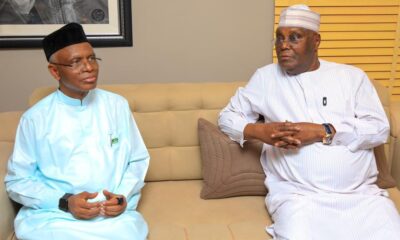

BREAKING: Atiku Appoints El-Rufai, Hayatu-Deen in ADC Presidential Campaign Council
Atiku Abubakar has announced the appointment of Nasir el-Rufai and Mohammed Hayatu-Deen to key positions in his African Democratic Congress,...

NECO Releases 2026 SSCE Results, Records Drop in Examination Malpractice
NECO has released the 2026 SSCE results, with 1,496 candidates recorded for examination malpractice, representing a 64.74% decrease from 2025.


PHOTOS: Anthony Joshua Endures ‘Torture’ Training Ahead of Fury Fight
Anthony Joshua has stepped up his preparations for a potential Tyson Fury showdown with an unusual stretching machine that has...


Umahi Orders Tinubu’s Pictures on First Niger Bridge
Works Minister David Umahi has ordered that President Bola Tinubu’s pictures be displayed on the First Niger Bridge after its...