
Politics
Tinubu Allocates ₦5.41 Trillion to Security in ₦58.47 Trillion 2026 Budget, Highest Sectoral Spending
President Bola Tinubu has earmarked ₦5.41 trillion for defence and security in the proposed 2026 budget, making it the largest allocation as the government prioritises…

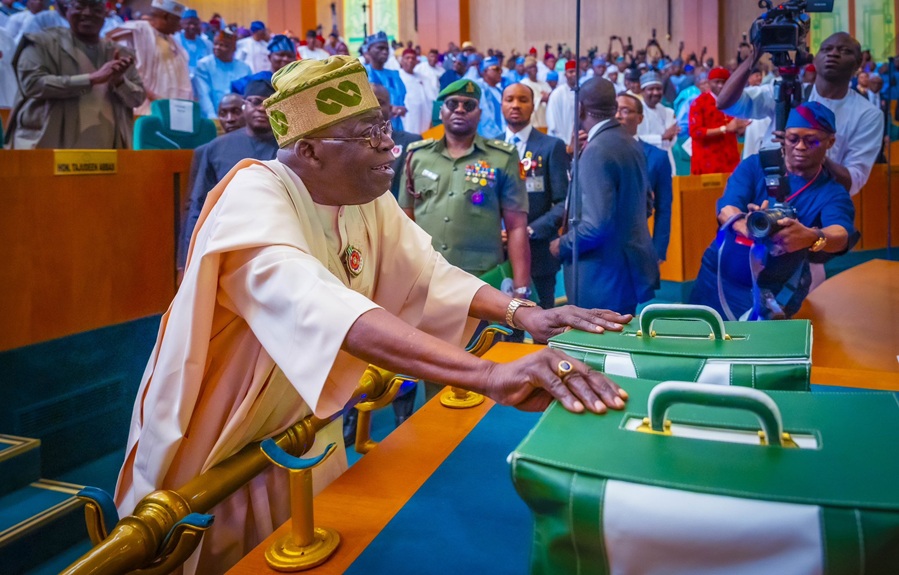
- President Bola Tinubu has earmarked ₦5.41 trillion for defence and security in the proposed 2026 budget, making it the largest allocation as the government prioritises national security amid ongoing threats.

President Bola Tinubu has earmarked ₦5.41 trillion for defence and security, the single largest allocation in the proposed 2026 budget.
The allocation marks the third consecutive year that security spending has taken top priority since the administration began presenting national budgets in November 2023.
Tinubu disclosed this on Friday while presenting the ₦58.18 trillion 2026 Appropriation Bill to a joint session of the National Assembly, stating that national security remains the foundation of economic growth, investment and social stability.
Under the proposal, defence and security will receive ₦5.41 trillion, ahead of infrastructure, education and health. This continues a pattern seen in the 2024 and 2025 budgets, where security consistently attracted the highest funding amid persistent threats from terrorism, banditry and kidnapping.
“Security remains the foundation of development,” the President told lawmakers, stressing that without peace and stability, other sectors of the economy would struggle to thrive.
Earlier in the day, the Federal Executive Council approved the 2026 budget framework at an emergency meeting presided over for the first time by Vice President Kashim Shettima. The council pegged total expenditure at ₦58.47 trillion, citing pressures from debt service, wages and security obligations.
Breaking down the proposal, Tinubu said the security allocation would be used to modernise the armed forces, strengthen intelligence-led policing, enhance border surveillance and support joint operations among security agencies.

“We will invest in security with clear accountability for outcomes because security spending must deliver security results,” he said.
The President also announced a major reset of Nigeria’s national security architecture, including a new national counter-terrorism doctrine based on unified command, intelligence coordination and community stability.
Under the proposed framework, all armed groups operating outside state authority—including bandits, militias, kidnappers, armed gangs and violent cult groups—will be classified as terrorists, along with their financiers, informants and political or community enablers. Tinubu said the tougher stance was necessary to close legal and operational gaps that had allowed violent groups to thrive.
DON’T MISS: Defecting to APC Was an ‘Easy Choice,’ I Was Only on PDP’s ‘Balcony’ — Fubara
Beyond security, the 2026 budget proposes ₦3.56 trillion for infrastructure, ₦3.52 trillion for education and ₦2.48 trillion for health.
While acknowledging pressure on public finances, Tinubu insisted that prioritising security was unavoidable, linking it to broader development goals and urging lawmakers to support the proposal as a means of restoring public confidence in the state’s ability to protect lives and property.






Champions League Quarter-Finals Confirmed, See Fixtures
The UEFA Champions League quarter-final lineup is set, with blockbuster clashes including PSG vs Liverpool and Real Madrid vs Bayern...


‘We Miss Aregbesola’: Nigerian Youths Slam Tunji-Ojo Over Public Holiday Declaration (Video)
Nigerian youths have criticised Interior Minister Olubunmi Tunji-Ojo over the choice of Thursday and Friday as Eid-el-Fitr holidays.

Israel Kills of Iran’s Intelligence Minister Esmail Khatib
Israel says it has killed Iran’s Intelligence Minister Esmail Khatib, though Iranian authorities have yet to confirm the claim amid...


Rival Fans Hold Mock Candlelight Procession for Chelsea After 8–2 Loss to PSG in Champions League (Video)
A viral video shows rival fans staging a mock candlelight procession for Chelsea after their 8–2 aggregate loss to Paris...


74-Year-Old Woman Gifts Governor Soludo Live Fowl at Inauguration (Video)
A 74-year-old woman drew attention at Governor Chukwuma Soludo’s inauguration in Awka after presenting a live fowl in appreciation of...

‘This War Will Hit Everyone No Matter Race, Religion’ – Iran Warns
Iran’s Foreign Minister Abbas Araghchi has warned that the ongoing war will impact people worldwide, urging more international voices to...

Court Declares It Legal to Record Police Officers on Duty
A Federal High Court in Warri has affirmed the right of Nigerians to record police officers in public.

BREAKING: FG Declares Two-Day Public Holiday
The Federal Government has announced two-day public holiday.

IPOB Accuses Nigerian Govt, Army of Plot to Demonise Group and Justify Attacks in South-East
The Indigenous People of Biafra has accused the Nigerian government and the military of fabricating insecurity in the South-East.


List of Approved 114 Universities to Run Law Programmes in Nigeria (Full List)
The Council of Legal Education has released the list of 114 universities authorised to run Bachelor of Laws (LL.B) programmes...