
Politics
Akpabio, Oshiomhole Clash as Senate Reverses Controversial Principal Offices Rule
The Senate has rescinded parts of its controversial Standing Orders amendments after concerns over constitutional inconsistencies…

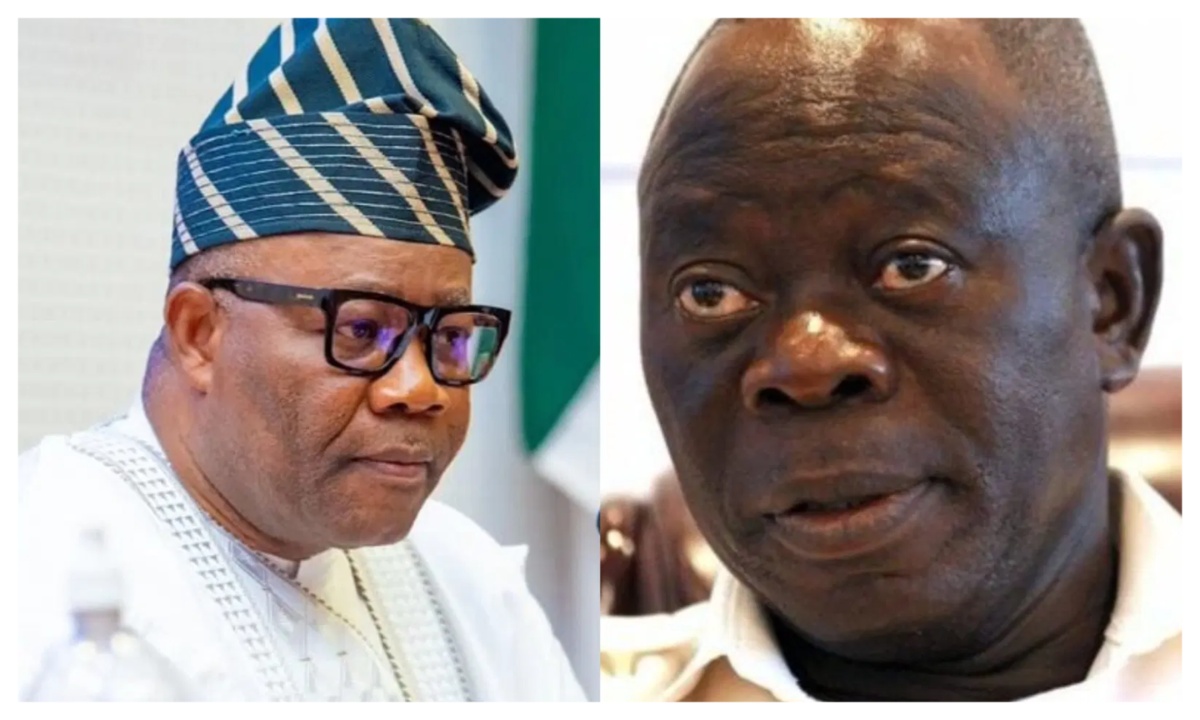
- The Senate has rescinded parts of its controversial Standing Orders amendments after concerns over constitutional inconsistencies.
- Adams Oshiomhole launched a fresh attack on Senate President Godswill Akpabio, urging him to resign over the disputed rules.

The Senate on Thursday reversed parts of its controversial 2026 Standing Orders amendments following concerns that some provisions conflicted with the 1999 Constitution.
The decision came just days after the upper chamber amended sections of its rules, triggering controversy and heated exchanges among lawmakers.
The development also sparked a sharp reaction from the senator representing Edo North, Adams Oshiomhole, who criticised the amendment process and called on Senate President Godswill Akpabio to step down.
The amendments had drawn attention amid growing interest from outgoing governors and political heavyweights seeking to enter the Senate ahead of the 2027 elections and contest for key leadership positions, including Senate President and Deputy Senate President.
During plenary, Senate Leader Opeyemi Bamidele moved the motion for rescission, explaining that a fresh legislative and constitutional review revealed that some of the provisions introduced under Order 2 Subsection 2 and Order 3 Subsection 1 could conflict with Section 52 of the Constitution.
“The Senate observes that upon further legislative and constitutional review, certain provisions introduced under Order 2 Subsection 2 and Order 3 Subsection 1 may give rise to constitutional inconsistencies,” he said.
Bamidele added that the Senate retained the authority to revisit and reverse earlier decisions in order to protect the integrity of its proceedings.
The motion was seconded by Senator Enyinnaya Abaribe and adopted by the chamber.
Deputy Senate President Jibrin Barau, who presided over the session, described the move as necessary to align Senate procedures with constitutional provisions.
“This is a very straightforward motion. It is just for us to go in conformity with the Constitution,” Barau said.
Oshiomhole, however, faulted the process that led to the earlier amendments, accusing lawmakers of rushing the changes to satisfy vested interests.
“The way we rushed the rules because certain people wanted certain things concluded is one flaw in this process,” he said.
His comments triggered another round of exchanges on the floor, with Bamidele warning against reopening already decided matters without a substantive motion.
Speaking with journalists after plenary, Oshiomhole described the amended rules as suffering from a “moral crisis,” arguing that Akpabio himself would not meet the standards contained in the proposed framework.
“As we speak today, the Senate President has not done eight years in office. So if we pass the rule that senators must do eight consecutive years before becoming Senate President, it means he should vacate the seat,” Oshiomhole said.
He also criticised attempts to alter long-standing Senate traditions for political convenience, warning against restricting eligibility for leadership contests in the upper chamber.
DON’T MISSS: 2027: Jonathan considers comeback as court hears eligibility suit today
Meanwhile, the Senate dismissed reports that the Presidency influenced the reversal of the amendments, insisting the action was purely procedural and intended to avoid constitutional conflicts.
Chairman of the Senate Committee on Judiciary, Human Rights and Legal Matters, Adeniyi Adegbomire, clarified that the controversy centred on whether senators-elect must first be sworn in before participating in the election of Senate presiding officers.
He explained that the rescinded provision related to oath-taking procedures and eligibility for voting during leadership elections, adding that the Senate acted to ensure clarity and constitutional compliance.
The Senate Standing Orders regulate legislative procedures, debates, voting processes and leadership elections in the upper chamber.





Akpabio Speaks on Taking Over as Acting President Amid Tinubu’s Absence
Senate President Godswill Akpabio has dismissed claims that he is Nigeria’s Acting President as opposition figures demand answers over Tinubu’s...

2027: Ex SGF, Lawal Dumps ADC for NDC, Backs Obi–Kwankwaso Ticket
Former SGF Babachir Lawal has joined the NDC, saying concerns over poverty, hunger and insecurity prompted his return to active...

Police Arrest Enugu Man Who Allegedly Kills Girlfriend Over HIV Status, Hides Body in Toilet
Police in Enugu have arrested a 30-year-old man accused of killing his girlfriend during an argument over HIV infection and...

NECO Announces Date for Release of 2026 SSCE Results
The National Examinations Council has announced that the results of the 2026 Senior School Certificate Examination Internal will be released...

BREAKING: CBN Slashes Interest Rate to 23% in Biggest Cut of Current Policy Cycle
The Central Bank of Nigeria has cut its benchmark interest rate by 350 basis points to 23 per cent, citing...


Motorists, Residents Stranded as Over 100 Cows Bring Calabar-Itu Highway to Standstill (Photos)
Traffic was brought to a standstill along the Calabar-Itu highway after more than 100 cattle spread across the busy road,...

Makinde Fires Back at Wike Over N50bn Ibadan Airport Claim
Oyo State Governor and APM presidential candidate Seyi Makinde has rejected Nyesom Wike’s claim that the Federal Government provided N50bn...

IPOB Asks: Where Was the Terrorism Between August and September 2017?
IPOB questions what changed between its August 2017 peace meeting with South-East governors and the September proscription that labelled the...

FULL LIST: Peter Mbah Approves Appointment of 101 New Aides
Governor Peter Mbah of Enugu State has approved the appointment of 101 new political aides, comprising seven Special Advisers, six...

Tinubu Abroad: Presidency Explains Who Is Running Nigeria
Presidential adviser Daniel Bwala has said President Bola Tinubu can continue to exercise his presidential responsibilities while outside Nigeria.....