
Business
FG Counters Air Peace CEO’s Claim on New Tax Laws
The Federal Government has dismissed claims by Air Peace CEO Allen Onyema that Nigeria’s new tax reforms will hurt airlines and push ticket prices sky-high.

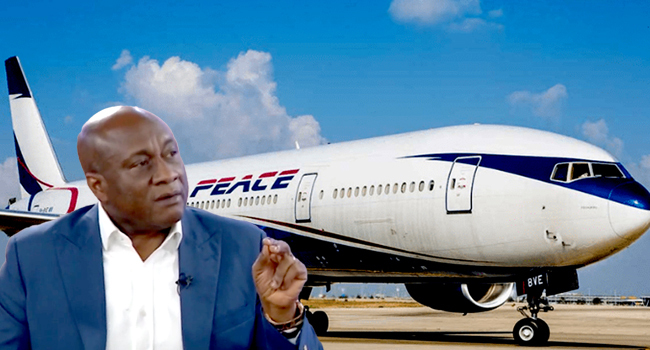
- The Federal Government has dismissed claims by Air Peace CEO Allen Onyema that Nigeria’s new tax reforms will hurt airlines and push ticket prices sky-high.

The Federal Government has firmly rejected assertions by Air Peace Chairman and CEO Allen Onyema that Nigeria’s upcoming tax reforms will cripple the aviation industry and sharply increase airfares.
The claims, made by Onyema during a Sunday interview on Arise News, were countered on Monday by Taiwo Oyedele, Chairman of the Presidential Committee on Fiscal Policy and Tax Reforms.
Oyedele described the allegations as misleading, noting that the reforms, effective January 2026, are intended to reduce costs, harmonise taxes, and improve sustainability within the sector.
Onyema had warned that the Nigeria Tax Act would reintroduce a 7.5% Value Added Tax on aircraft imports, engines, and spare parts, arguing that domestic ticket prices could jump from about ₦350,000 to over ₦1m.
However, Oyedele clarified that the reforms are “part of the solution, not the source of the problem. Several long-standing tax issues driving costs in the sector have been resolved in the new tax laws or are being structurally addressed.”
He explained that the existing 10% withholding tax on aircraft leasing, previously non-recoverable and a significant cost burden, will now be either fully exempt or significantly reduced under regulation.
On VAT concerns, Oyedele said airlines will become fully VAT-neutral, allowing input VAT on imported or locally procured assets, consumables, and services to be fully claimable—with refunds mandated within 30 days or offset against other tax liabilities.
DON’T MISS: Dangote Group Appoints Former CBN Director Dr Mahmud Hassan as Group Chief Economist
Oyedele also dismissed claims that import duties on aircraft and spare parts were being reinstated, affirming that existing exemptions remain intact, and emphasised that ticket price increases projected by Onyema were exaggerated. “Even in a worst-case scenario, a ₦350,000 ticket would rise to about ₦376,250, not ₦1.7m,” he noted.
The reforms also include a reduction in corporate income tax from 30% to 25% and the consolidation of multiple levies—including Tertiary Education Tax, NASENI, NITDA, and Police levies—into a single Development Levy, reducing complexity and improving certainty for airlines.

Additionally, Nigeria Civil Aviation Authority spokesperson Michael Achimugu dismissed claims that domestic airlines pay as many as 18 taxes, insisting that “any domestic carrier operating domestic flights that says they are paying 18 taxes is a liar.” Achimugu attributed recent fare spikes to seasonal market forces rather than the new tax laws.
Both Oyedele and Achimugu stressed that while airlines still face multiple levies, these were not created by the 2026 tax reforms, and the government remains committed to working with operators and agencies to improve the sector.
The Federal Government insists that the reforms are structural solutions aimed at lowering costs, enhancing liquidity, and ensuring the aviation industry’s long-term sustainability.





King Mitchy Management Retracts Death Claim After Suicide Attempt Using Hypo
King Mitchy’s management has given fresh update on her death report after attempting to commit suicide by drinking hypo...


Is VeryDarkMan and King Mitchy Dead After Drinking Hypo? What We Know So Far (Video)
Confusion surrounds reports involving VeryDarkMan and King Mitchy death rumor after attempts to commit suicide by drinking hypo...


PHOTOS: All You Need to Know as Alex Otti Flags Off Enyimba-Radisson Hotel Project in Aba
Governor Alex Otti has commissioned the reconstructed Ovom Road and flagged off the Enyimba-Radisson Hotel in Aba.


IPOB Raises Alarm Over Sharia Debate, Says Nigeria’s Structure Threatens Religious Freedom
IPOB has warned that ongoing debates over Sharia law highlight deeper structural issues in Nigeria...


Businesswoman Who Accused Umahi of ₦250m Debt Collapses After Arrest, Hospitalised in Abuja (Video)
Businesswoman Tracy Nicolas Ohiri collapsed and was hospitalised in Abuja after her arrest over cyberbullying allegations linked to a ₦250...


Bandits Kill 29, Abduct Many in Fresh Attacks
Coordinated attacks across Adamawa, Kebbi, Sokoto, and Kwara states have left dozens dead and many abducted.

INEC Shifts 2027 Elections, Releases Full Revised Timetable
INEC has brought forward Nigeria’s 2027 general elections to January and February, releasing a detailed timetable after adjusting the schedule...


BREAKING: Court Jails Popular Herbalist Akwa Okuku Tiwaraki na Oba, Orders Shrine Demolition
A court has sentenced popular herbalist Akwa Okuku Tiwaraki na Oba to 11 months imprisonment, ordered the demolition of his...

BREAKING: Fubara Appoints New Chief of Staff, SSG
Governor Siminalayi Fubara has appointed new top aides in Rivers State, a move coming amid ongoing political tension.


Embarrassing Moment ‘Nepa’ Took Light During Tunji Disu’s Decoration as Acting IGP in Abuja (Video)
A power outage disrupted the decoration of Tunji Disu as acting IGP in Abuja, sparking reactions after the incident occurred...