
News
₦70,000 No Longer Enough: NLC Gives FG Two Weeks to Act on Petrol Prices, Wages
The NLC says rising living costs have eroded the ₦70,000 minimum wage, insisting its ultimatum over petrol prices and fresh wage talks remains in force.


- The NLC says rising living costs have eroded the ₦70,000 minimum wage, insisting its ultimatum over petrol prices and fresh wage talks remains in force.

The Nigeria Labour Congress has insisted that its two-week ultimatum to the Federal Government remains in force, warning that workers are struggling to survive despite the increase in the national minimum wage to ₦70,000.
NLC President Joe Ajaero, speaking on Monday in Abuja, called for urgent intervention over rising petrol prices and declining purchasing power, saying the government should address workers’ concerns before they escalate into industrial action.
He spoke at a retreat organised by the National Salaries, Incomes and Wages Commission, where government officials also called for a sustainable approach to wage administration.
Ajaero maintained that correspondence between organised labour and government officials had not changed the union’s position on its demands for petrol price relief and fresh wage negotiations.
“I’ve not come here to discuss my ultimatum. My ultimatum stands. I’ve said something about it, and this is not a table. The fact that the permanent secretary is here does not give us the opportunity to start negotiating an ultimatum. He has replied a letter, and we have replied him again. So, we will go into that game.
“But to the head of service, sir, Nigerian workers are really suffering. And if you do something, history and posterity will remember all of us for it.”
The labour leader said the ₦70,000 minimum wage agreed in 2024 had failed to keep pace with basic household expenses, particularly food and transportation.
He stressed that the union’s concern was workers’ survival rather than embarking on a strike.
“The point we are making is not strike. The point we are making is that whether you enter bus or you buy fuel, you will not be able to eat.”
Ajaero urged the government to introduce timely relief measures, arguing that authorities should not wait for street protests before responding to hardship.
“But to wait for Labour to be on the street before we address this is not really what is happening all over the world. Countries all over the world will come with interventionary measures even before Labour acts on it. I think we should be more proactive,” he stated.
He also challenged claims that the implementation of the 2024 wage agreement delivered salary increases of about 133 per cent to federal workers.
According to Ajaero, the adjustment amounted to an additional ₦40,000 for federal public servants, which he argued did not reflect the percentage increase being cited.
“All the federal public service workers, they added 40,000 to them. 40,000 does not translate to 100 per cent or 133 per cent. And the consequences are what we are facing now, sir.”
He raised concerns about unresolved labour disputes, including issues behind an 84-day health workers’ strike that organised labour helped suspend.
Ajaero also said workers under the National Public Service Negotiating Council had considered industrial action but were persuaded by labour leaders to hold back.
Rejecting suggestions that politicians were influencing the union’s demands, he said workers were entitled to seek better living conditions.
“No politician can use us. That’s the greatest insult, to tell me at this age and time, you know, to say a politician is using you when you ask for increase of workers’ salaries,” he said.
Meanwhile, Secretary to the Government of the Federation, George Akume, urged the wages commission to weigh workers’ expectations against the government’s financial capacity.
Represented by Dr Abubakar Kana, Permanent Secretary of the General Services Office, Akume said wage policies must protect industrial harmony while reflecting economic realities.
“The commission must continually balance the legitimate expectations of workers with the fiscal realities of government and broader imperatives of national economic development.”
He called for stronger research, policy coordination and digital systems to help the commission anticipate wage challenges and prevent avoidable disputes.
The commission’s Chairman and Chief Executive Officer, Junaidu Bindawa, said inflation, changing labour expectations and demands for public sector efficiency required a more strategic approach to salaries and compensation.
He said the retreat, themed Vision, Strategy and Institutional Renewal, should produce a practical roadmap with clear priorities and measurable results.
Commission Secretary Olajumoke Okoya-Thomas also advocated a permanent, evidence-based approach to wage reviews rather than decisions driven by emergencies.
“We exist so that wage decisions rest on evidence, not emergencies,” she said.
She added that the commission’s proposed action plan would assign responsibilities, timelines and performance indicators to ensure its recommendations were implemented.





2027: North Will Reject Tinubu and His Money — Hakeem Baba-Ahmed Says
Hakeem Baba-Ahmed has accused Tinubu’s administration of neglecting Northerners and warned against financial inducements...

Abia PDP Candidate Anosike Pledges to Reopen Ukwa East Oil Wells, Revive Industries
Abia PDP governorship candidate Kelechi Anosike has promised to pursue the reopening of capped oil wells, revive Abia Palm and...
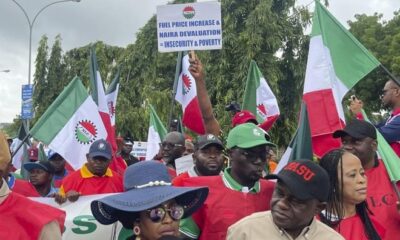

₦70,000 No Longer Enough: NLC Gives FG Two Weeks to Act on Petrol Prices, Wages
The NLC says rising living costs have eroded the ₦70,000 minimum wage, insisting its ultimatum over petrol prices and fresh...

IPOB Embraces Hausa People, Backs Self-Determination for All Ethnic Groups
The Indigenous People of Biafra (IPOB) has declared its solidarity with the Hausa people and other ethnic nationalities in Northern...


IPOB-Hausa Brotherhood: Writer Traces Historical Ties, Renews Call for Biafra Referendum
A Nigerian writer, Khaleed Yazeed, has argued that historical trade relations between the Igbo and Hausa peoples provide a basis...

IPOB: No Hausa, No Jukun, No Birom Has Ever Ruled Nigeria — Their Turn Will Never Come Under This System
The Indigenous People of Biafra (IPOB) has renewed its demand for a referendum on Biafran self-determination, while calling for the...

Catholic Priest Dies as Cross Falls on Him During Livestreamed Mass
A Catholic Priest Father Patricio Sánchez Molinari died after a large wooden cross fell on him while he celebrated Mass...
IPOB Embraces Hausa Nation and All Northern Ethnic Nationalities in Historic Solidarity Declaration for Universal Freedom
IPOB has declared solidarity with Hausa people and other ethnic nationalities in Northern Nigeria, calling for a peaceful...

Nnamdi Kanu’s Legal Team Raises Fresh Questions Over Omotosho’s Judgment in Part 3 Commentary
Onyedikachi Ifedi, Esq., has questioned the legal basis of Nnamdi Kanu’s conviction, alleging irregularities involving Count 7....

IPOB Denies Plans to Resume Monday Sit-at-Home, Rejects Alleged Police Intelligence Report
IPOB has dismissed a purported police intelligence report alleging plans to resume Monday sit-at-home enforcement in the South-East...