
Politics
2027: OK Movement Rejects NDC Takeover, Vows to Keep Its Structures
The Obi-Kwankwaso Movement has rejected calls for support groups to operate under the Nigeria Democratic Congress, insisting that it will retain its independent national…

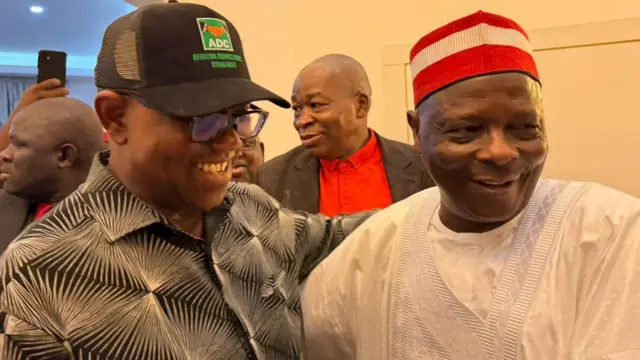
- The OK Movement has rejected calls for support groups to operate under the Nigeria Democratic Congress, insisting that it will retain its independent national, state, local government and ward structures ahead of the 2027 elections.

The Obi-Kwankwaso Movement, popularly known as the OK Movement, has vowed not to collapse or surrender its organisational structures to the Nigeria Democratic Congress ahead of the 2027 general elections.
The movement’s Director-General, John Ughulu, said the organisation would maintain its national, state, local government and ward structures despite its political alignment with the NDC’s presidential ticket.
Ughulu made the position known on Wednesday while responding to comments by the NDC National Leader, Senator Seriake Dickson, on the role of support groups in the party’s 2027 campaign.
Dickson had argued that political support groups should complement the political party rather than compete with it or establish structures that perform the functions of the party’s official campaign machinery.
The former Bayelsa governor made the comments while receiving former Secretary to the Government of the Federation, Babachir Lawal, into the NDC in Abuja.
Dickson also criticised the OK Movement’s decision to establish a 59-member Presidential Campaign Council, describing the move as “unheard of” and “nonsensical”.
The disagreement followed the NDC’s earlier decision to dissociate itself from the 59-member campaign council announced by the OK Movement.
The party’s National Chairman, Senator Moses Cleopas, said the structure did not emanate from the NDC and should be disregarded, adding that only the party leadership could constitute and announce a presidential campaign council on behalf of the party.
OK Movement Defends Its Independence
Responding to Dickson, Ughulu argued that the OK Movement should not be treated as an ordinary support group established as an appendage of the NDC.
He said the movement was independently organised and had its own leadership, management and internal structures.
“I strongly agree with the position expressed by Senator Seriake Dickson. However, there appears to be a missing link in the argument currently being advanced,” Ughulu said.
He argued that if the Obidient and Kwankwasiyya movements were regarded as support movements, there was a need to clearly define the identity and status of the OK Movement.
“For the avoidance of doubt, the OK Movement is not a support group created as an appendage of any political party or another movement. It is independently organised, managed and structured through its own established movement mechanisms,” he said.
Ughulu also rejected Dickson’s description of the movement’s decision to establish a campaign council as “nonsensical”.
According to him, the OK Movement consists of individuals and members of different political parties who share support for Peter Obi and Rabiu Kwankwaso, the NDC’s presidential and vice-presidential candidates for the 2027 election.
“So it is not nonsensical as claimed by Seriake Dickson; rather, the national leader of the NDC Party should come to realise that politics has long evolved from the conventional political system he is used to,” he said.
“The OK Movement comprises individuals and members from different political parties who share a common commitment to the ideals, values and political aspirations represented by the presidential candidate, Peter Obi and his running mate, Senator Rabiu Kwankwaso,” he added.
Movement Rejects Merger With NDC
Ughulu said the movement would continue to mobilise support for Obi and Kwankwaso while maintaining its organisational independence.
“The OK Movement remains an independent organisation. Its existence and internal administration are not subject to the internal management of the NDC.
“The OK Movement will not be collapsed, merged or subsumed into the NDC or any other organisation. Cooperation and political alignment do not extinguish the independent identity of the Movement,” he said.
He added that the movement would not hand over its established structures to the NDC or another organisation.
“Our organisational structure remains the property and responsibility of the OK Movement. We will not surrender our established national, state, local government and ward structures to any political party or external support group for management,” Ughulu said.
The Director-General further argued that the movement had the right to establish its own campaign and mobilisation structures in support of the NDC candidates.
He said the movement was not seeking to take over the authority of the NDC or interfere with the party’s internal affairs.
“Let us also make one important distinction absolutely clear. The OK Movement does not claim supremacy over the NDC Party, nor does it seek to usurp the constitutional powers of the party,” he said.
“We respect the NDC and recognise the constitutional authority of the party over its own internal affairs. Equally, the NDC and every other organisation must recognise the independent identity, structure and legitimate interests of the OK Movement.”
Ughulu, however, warned that the movement would oppose any attempt to take control of its structures.
“We will resist, through lawful and democratic means, any attempt by any individual or group to disenfranchise members of the movement, appropriate its structures, or unilaterally redefine its identity,” he said.
“We did not build the OK Movement overnight.
“Therefore, no individual can simply declare that structure dissolved, transferred or absorbed without the authority of the Movement’s legitimate organs. We will not be intimidated, surrender our identity or abandon the structures we have built,” he added.
Dispute Over 59-Member Campaign Council
The latest disagreement is linked to the OK Movement’s decision to establish a 59-member Presidential Campaign Council to mobilise support for Obi and Kwankwaso ahead of the 2027 election.
The movement unveiled the council on September 17, with Ughulu named as Director-General and Saadatu Sani as National Secretary. The structure includes zonal and state coordinators as well as officials responsible for areas including mobilisation, women’s affairs, strategy, security and legal affairs.
The NDC subsequently distanced itself from the council, saying it had not been authorised by the party.
The party warned that no individual, candidate or support group could establish or announce a campaign structure in the name of the NDC without approval from its National Working Committee.
The OK Movement responded that it did not require approval from an individual within the NDC to carry out what it described as its legitimate organisational activities.
The movement has maintained that its collaboration with the NDC over the Obi-Kwankwaso ticket does not amount to organisational subordination.
Meanwhile, the NDC has indicated that it will inaugurate its own Presidential Campaign Council for the 2027 elections, following the disagreement over the separate structure announced by the OK Movement.





2027: OK Movement Rejects NDC Takeover, Vows to Keep Its Structures
The Obi-Kwankwaso Movement has rejected calls for support groups to operate under the Nigeria Democratic Congress, insisting that it will...

Akpabio Speaks on Taking Over as Acting President Amid Tinubu’s Absence
Senate President Godswill Akpabio has dismissed claims that he is Nigeria’s Acting President as opposition figures demand answers over Tinubu’s...

2027: Ex SGF, Lawal Dumps ADC for NDC, Backs Obi–Kwankwaso Ticket
Former SGF Babachir Lawal has joined the NDC, saying concerns over poverty, hunger and insecurity prompted his return to active...


Police Arrest Enugu Man Who Allegedly Kills Girlfriend Over HIV Status, Hides Body in Toilet
Police in Enugu have arrested a 30-year-old man accused of killing his girlfriend during an argument over HIV infection and...

NECO Announces Date for Release of 2026 SSCE Results
The National Examinations Council has announced that the results of the 2026 Senior School Certificate Examination Internal will be released...

BREAKING: CBN Slashes Interest Rate to 23% in Biggest Cut of Current Policy Cycle
The Central Bank of Nigeria has cut its benchmark interest rate by 350 basis points to 23 per cent, citing...

Motorists, Residents Stranded as Over 100 Cows Bring Calabar-Itu Highway to Standstill (Photos)
Traffic was brought to a standstill along the Calabar-Itu highway after more than 100 cattle spread across the busy road,...

Makinde Fires Back at Wike Over N50bn Ibadan Airport Claim
Oyo State Governor and APM presidential candidate Seyi Makinde has rejected Nyesom Wike’s claim that the Federal Government provided N50bn...

IPOB Asks: Where Was the Terrorism Between August and September 2017?
IPOB questions what changed between its August 2017 peace meeting with South-East governors and the September proscription that labelled the...

FULL LIST: Peter Mbah Approves Appointment of 101 New Aides
Governor Peter Mbah of Enugu State has approved the appointment of 101 new political aides, comprising seven Special Advisers, six...