
Politics
Key Things to Know About Obi, Kwankwaso’s New Party, NDC
The newly registered Nigeria Democratic Congress (NDC) is gaining national attention after high-profile defections and rapid political alignment ahead of the 2027 general elections.

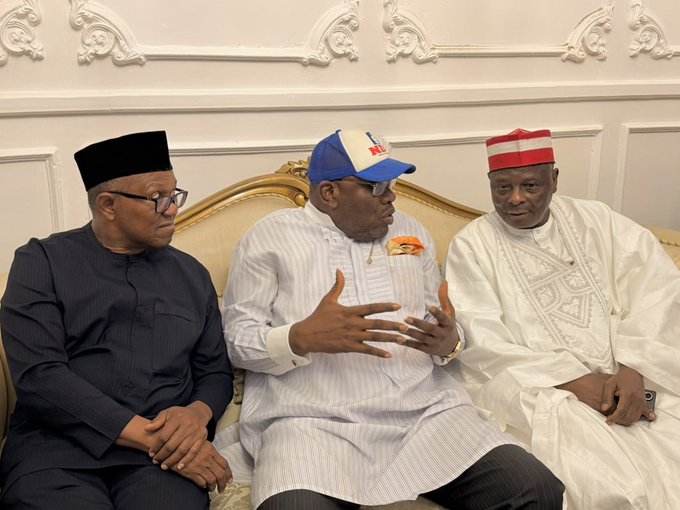
- The newly registered Nigeria Democratic Congress (NDC) is gaining national attention after high-profile defections and rapid political alignment ahead of the 2027 general elections.

The Nigeria Democratic Congress has quickly entered national political conversations following its formal registration by the Independent National Electoral Commission and its growing ties with prominent opposition figures ahead of the 2027 general elections.
Former Labour Party presidential candidate Peter Obi and ex-Kano State governor Rabiu Kwankwaso formally joined the party on Sunday in Abuja, urging members to avoid internal disputes and focus on national development. Obi confirmed his switch shortly after resigning from the African Democratic Congress, which he had joined in December.
Registration and legal background
The NDC was officially registered by INEC on February 5, 2026, alongside the Democratic Leadership Alliance, following years of legal disputes dating back to 2017. Its recognition came after a Federal High Court ruling compelled INEC to approve its registration, placing it among politically reactivated platforms that gained legitimacy through judicial processes.
Leadership structure
The party has since established an interim national leadership pending its inaugural convention. Cleopas Zuwoghe serves as National Chairman, with Ikenna Enekweizu as Secretary, John Odey as Treasurer, and Mainasara Sani as Financial Secretary. The party noted that Reuben Egwuaba, listed as National Legal Adviser, has reportedly resigned. These positions are pro-tempore, pending ratification at the party’s national convention.
To ensure regional balance, the party appointed National Vice Chairmen across the six geopolitical zones, including Mohammed Bakin Zuwo (North West), Danlami Arabs (North East), Barnabas Ejisi (North Central), Barr. Frederick Owotorufa (South South), Teddy Obey (South East), and Adedayo Ekong (South West). Officials say the structure is designed to promote inclusion and national representation.
State structure and expansion
The NDC has also established pro-tem leadership across all 36 states and the Federal Capital Territory, including Hussaini Isa Meriga (Kano), Ibrahim Bebebtu (Adamawa), and Bello Sani Yabo (Sokoto). These structures are expected to be consolidated through upcoming state congresses.
Dickson’s influence and political positioning
Former Bayelsa State governor Seriake Dickson is widely regarded as the political anchor of the party’s coalition efforts, playing a key role in alliance-building and opposition coordination.
DON’T MISS: Why INEC Restores David Mark as ADC National Chairman
Since its registration, the party has launched a digital membership drive and commenced nationwide congresses on May 1, 2026. Its inaugural national convention is scheduled for May 9, 2026, in Abuja, where it is expected to adopt its constitution, ratify leadership, and outline its electoral strategy ahead of the 2027 elections.
The party’s agenda focuses on national unity, youth inclusion, electoral reform, and coalition-driven politics. With rising political alliances and increasing visibility, the NDC is positioning itself as a growing opposition platform, though its long-term influence will depend on how effectively it consolidates its structure and translates momentum into electoral strength.





IGP Disu Redeploys New Commissioners of Police to Eight States
Inspector-General of Police Olatunji Disu has approved the deployment of new Commissioners of Police to eight state commands and key...


‘You Don’t Have to Get Married or Have Kids’ — Actress Tayo Adeniyi Tells Women
Nollywood actress Tayo Adeniyi has urged women not to base their happiness or self-worth on marriage and motherhood, saying they...


VIDEO: Residents Flee in Panic as Multiple Explosions Rock Abuja Near Filling Station
Residents fled in panic after multiple explosions were reported near Shafa Filling Station in Abuja's Apo Bridge area, with emergency...

US Visa Wait Time In Lagos And Abuja: How To Check Available Appointment Slots
US visa wait time in Lagos and Abuja explained: latest official appointment estimates, how Nigerians can check available slots, reschedule...


Army Arrests Two Soldiers Seen Acting as ‘Bouncers’ at Peller, Jarvis’ Wedding
The Nigerian Army has arrested two serving soldiers over their alleged involvement in an unauthorised deployment at the wedding of...


Air Peace Announces Flight Disruptions After FAAN Equipment Failure in Abuja
Air Peace has announced disruptions to some of its flight operations after a baggage screening machine at FAAN's domestic terminal...

Orji Kalu Backs Alex Otti for Second Term, Predicts Re-Election
Senator Orji Uzor Kalu has predicted that Abia State Governor Alex Otti will secure a second term in office, while...

Tinubu Has ‘No Competition’, Opposition Too Weak — Orji Kalu
Senator Orji Uzor Kalu says President Bola Tinubu remains the favourite to win the 2027 presidential election, insisting he has...


PFIPC DG Adeyemi Rejects Secret House Probe, Demands Public Hearing
Detained PFIPC DG Adeniyi Adeyemi has rejected plans by the House of Representatives to question him behind closed doors.

‘Why We Froze Osun Govt Accounts’ — EFCC
The EFCC says it froze Osun State Government accounts to stop the alleged diversion of public funds, revealing it is...