
News
Nnamdi Kanu’s Legal Team Raises Fresh Questions Over Omotosho’s Judgment in Part 3 Commentary
Onyedikachi Ifedi, Esq., has questioned the legal basis of Nnamdi Kanu’s conviction, alleging irregularities involving Count 7….

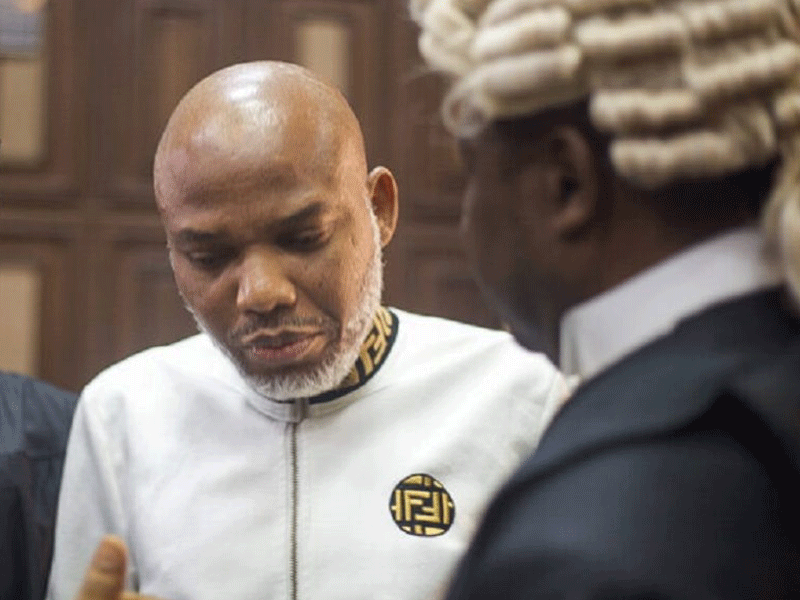
- Onyedikachi Ifedi, Esq., has questioned the legal basis of Nnamdi Kanu’s conviction, alleging irregularities involving Count 7, the failure to amend the charge and the application of a repealed law.

A legal commentary authored by Onyedikachi Ifedi, Esq., has raised fresh questions about the legal basis of the conviction of Indigenous People of Biafra (IPOB) leader, Mazi Nnamdi Kanu, focusing on alleged irregularities surrounding Count 7 of the charge and the application of criminal law by Justice James Omotosho.
In the third installment of his series, titled “Omotosho’s Third Jurisdictional Failure: The Triangle of Nullity,” Ifedi argued that Kanu was arraigned under one statutory framework, tried without a formal amendment to the charge and ultimately convicted under a different statute.
The lawyer contended that the alleged discrepancies amounted to a fundamental breach of due process rather than a mere technical error.
Dispute Over Count 7
According to the commentary, Count 7, formerly Count 15, was framed under the Criminal Code Act, Cap C-45, Laws of the Federation of Nigeria 2004.
Ifedi argued that the statutory reference was defective, alleging that it combined the title of one enactment with the chapter number of another.
He further claimed that the prosecution conducted the trial without formally correcting the charge, despite objections raised by Kanu.
The commentary stated that the defendant challenged the alleged defect in court on November 3, 2025, and requested an amendment to the charge. It alleged that Justice Omotosho declined to grant the request.
Lawyer Cites ACJA Provisions
Ifedi relied on Sections 216 and 218 of the Administration of Criminal Justice Act (ACJA) 2015 to support his argument that a defective charge should be formally amended through the prescribed legal procedure.
He maintained that where a charge is amended, the defendant must be called upon to enter a fresh plea to the amended charge.
The lawyer argued that the absence of a formal amendment and a fresh plea meant the court could not validly convict Kanu under a different statutory provision.
He also cited Sections 36(6)(a) and 36(12) of the 1999 Constitution, arguing that the alleged procedure violated the defendant’s constitutional rights to be informed of the offence against him and to be convicted only for an offence established under a written law.
Allegation of Conviction Under Repealed Law
A central claim in the commentary concerns the judgment reportedly delivered on November 20, 2025, in which Justice Omotosho allegedly relied on Section 47(2)(a) of the Customs and Excise Management Act (CEMA) to convict Kanu and impose a five-year prison sentence.
Ifedi argued that the provision was not included in the original charge and that the defendant was not given an opportunity to enter a fresh plea to an amended count based on that statute.
He further contended that CEMA had been repealed by the Nigeria Customs Service Act 2023, which took effect before the judgment.
According to the lawyer, the savings provisions of the new legislation could not preserve a charge that had never been formally brought against the defendant under CEMA.
The commentary cited several judicial authorities, including Aoko v. Fagbemi, FRN v. Usman, Ugwu v. State and MacFoy v. UAC, in support of its arguments on criminal liability, fair hearing and the consequences of legal defects.
Call for Compliance With Due Process
Concluding the commentary, Ifedi maintained that the alleged differences between the statute cited in the charge, the legal framework used during the trial and the provision relied upon in the judgment raised fundamental questions about the validity of the conviction.
He argued that a conviction based on an offence that was not properly included in the charge, without the required amendment and fresh plea, could not stand.
The publication forms Part 3 of a legal commentary series examining what its author describes as judicial errors in Kanu’s trial. The author said subsequent installments would address additional issues arising from the proceedings.
The allegations and legal interpretations presented in the commentary remain attributable to its author. An independent examination of the certified court record, the judgment and the relevant statutory provisions would be necessary to establish the accuracy of the claims and their legal implications.






Nnamdi Kanu’s Legal Team Raises Fresh Questions Over Omotosho’s Judgment in Part 3 Commentary
Onyedikachi Ifedi, Esq., has questioned the legal basis of Nnamdi Kanu’s conviction, alleging irregularities involving Count 7....


IPOB Denies Plans to Resume Monday Sit-at-Home, Rejects Alleged Police Intelligence Report
IPOB has dismissed a purported police intelligence report alleging plans to resume Monday sit-at-home enforcement in the South-East...


‘No Negotiations, Only Referendum’ — Kanu’s Message to American Veterans of Igbo Descent
IPOB leader Nnamdi Kanu has reaffirmed his demand for a referendum on Biafra's self-determination, insisting he will reject any political...


IPOB Condemns NYSC Abductions in Imo, Accuses Uzodinma of Political Conspiracy
IPOB has condemned the reported abduction and rescue of NYSC members in Imo State, denying involvement and accusing Governor Hope...


Ambrose Alli University Lecturer Dies in Hotel Room After Sexual Encounter With 21-Year-Old Woman
A senior lecturer at Ambrose Alli University, Ekpoma, Dr Matthew Uwuigbe, has died in a hotel room in Edo State...


Omotosho’s First Jurisdictional Failure — The Court Lacked Authority to Try Kanu
The Mazi Nnamdi Kanu Global Legal Consortium has alleged that the Federal High Court lacked jurisdiction to try Kanu on...


‘No Government Without a Country’: IPOB Rejects Self-Appointed Biafra Government Officers
Mazi Chris Nwaọgụ has reiterated IPOB’s demand for Nnamdi Kanu’s freedom and Biafra’s restoration, while calling for Kanu’s appeal to...


Sokoto Declaration: Emma Powerful Dismantles False Claims, Reaffirms Onyendu Mazi Nnamdi Okwu Kanu’s Referendum Position
Kanu’s camp has rejected claims that he did not approve or co-sign the Sokoto Declaration, while stressing that he does...


Kanu’s Unlawful Conviction, the Law That Was Already Dead, and the Shame That Is Waiting for Nigeria’s Judiciary
Christopher Chidera, Esq., has challenged the legal basis of Nnamdi Kanu’s conviction, arguing that the trial court relied on a...


Elochukwu Ohagi Describes Nnamdi Kanu as ‘Anointed Builder’ in Biafran Cenotaph Tribute
Elochukwu Ohagi has described Nnamdi Kanu as an “anointed builder” and “divine instrument” in the struggle for Biafran restoration, highlighting...