
News
BREAKING: Senate Compels Meta, Google, X, TikTok Others to Open Offices in Nigeria
The Senate has advanced a bill that would compel global social media companies operating in Nigeria, including Meta, Google, X and TikTok, to establish physical offices in the country.

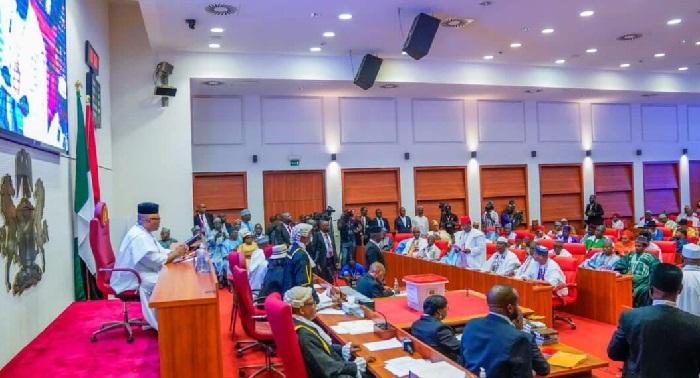
- The Senate has advanced a bill that would compel global social media companies operating in Nigeria, including Meta, Google, X and TikTok, to establish physical offices in the country.

The Senate on Thursday took a major step towards compelling global social media companies operating in Nigeria to establish physical offices in the country, as stakeholders overwhelmingly supported the proposal during a public hearing in Abuja.
The hearing, organised by the Senate Committee on Information and Communications Technology (ICT) and Cyber Security, also received strong backing for a separate bill seeking to establish an Artificial Intelligence (AI) Academy in Omuo-Ekiti, Ekiti State.
The social media bill, sponsored by Senator Ned Nwoko (Delta North), seeks to amend the Nigeria Data Protection Act, 2023, by making it mandatory for all social media companies offering services in Nigeria to maintain physical offices within the country’s territorial boundaries.
Speaking at the hearing, Chairman of the Senate Committee on ICT and Cyber Security, Senator Shuaib Salisu (Ogun Central), said both bills are designed to strengthen Nigeria’s digital economy and position the country for greater technological advancement.
According to him, while the social media bill aims to improve regulation, accountability and data protection within Nigeria’s cyberspace, the proposed AI Academy would serve as a national hub for artificial intelligence education, research and innovation.
President of the Senate, Godswill Akpabio, represented by Deputy Senate Leader Senator Lola Ashiru (Kwara South), described both bills as timely and forward-looking.
Akpabio stressed that the proposal requiring global technology companies to establish offices in Nigeria was not intended to hinder their operations but to encourage greater corporate responsibility and engagement with the country’s growing digital economy.
Defending the bill, Senator Nwoko rejected claims that the legislation could discourage foreign investment or target technology firms.
“This bill is neither punitive nor hostile to innovation. It is not designed to frustrate investment or discourage technology companies from operating in Nigeria.
“On the contrary, it seeks to deepen their engagement with Nigeria by encouraging them to become true corporate citizens of our country,” he said.
The lawmaker noted that many countries with significantly smaller populations and digital markets than Nigeria have successfully attracted global technology companies by encouraging them to establish regional headquarters and operational hubs.
He listed countries such as the United Kingdom, India, the United Arab Emirates, South Africa, Brazil, Singapore, Spain, Australia, Japan and the Netherlands, where companies like Meta, Google, LinkedIn, TikTok and X have established offices supporting engineering, artificial intelligence research, customer service, legal compliance, public policy and product development.
According to Nwoko, these countries have benefited from increased employment opportunities, technology transfer, improved regulatory engagement and higher tax revenues.
Using Ireland as an example, he said the presence of major technology firms had transformed the country into one of Europe’s leading technology hubs through innovation, job creation and foreign investment.
He argued that Nigeria, as Africa’s largest digital market, should not be left behind.
“The question is simple: if countries with significantly smaller populations and digital markets than Nigeria have secured these investments and benefits, why should Nigeria continue to stand on the sidelines? Why should Africa’s largest digital market not enjoy the same opportunities?” Nwoko asked.
The committee is expected to review memoranda submitted by stakeholders before presenting its final report to the Senate for further legislative consideration.
If passed into law, the bill could require major global social media and technology companies serving millions of Nigerian users to establish a physical presence in the country, potentially creating jobs, improving regulatory compliance and strengthening Nigeria’s rapidly expanding digital economy.






Ebola in Nigeria: How to Protect Yourself, Symptoms to Watch and Where to Get Help
Following the confirmation of an Ebola case in Abuja, here is essential safety advice for Nigerians, healthcare workers and travellers,...


Ebola: WHO Advises Against Travel, Trade Restrictions After Nigeria Confirms Case
WHO has advised against travel and trade restrictions on Ebola-affected countries as Nigeria monitors 44 contacts following an imported case...


Ebola: Five Things to Know About Bundibugyo Virus as Nigeria Confirms First Case
Nigeria has confirmed an imported Bundibugyo Ebola case in Abuja. Here are five key facts about its symptoms, transmission, treatment...


Italy Rejects 2,220 Nigerians Seeking Asylum
Italy rejected 2,220 Nigerian asylum claims in first-instance decisions in 2025, while 1,175 Nigerians received protection and 4,120 cases remained...

Dangote Buys 25% Stake in Kenya Pipeline Network, Plans $50bn Expansion
Aliko Dangote says his Group has acquired a stake in Kenya’s petroleum pipeline network as it expands fuel distribution infrastructure...


28-Year-Old POS Operator Sentenced to Death by Hanging Over Role in Kidnap Gang
An Imo court has sentenced a 28-year-old POS operator to death over his involvement in the abduction and murder of...


UTME: JAMB Considers Life Skills, Critical Thinking Tests for Admission Seekers
JAMB is considering adding life skills and critical thinking to the UTME, while introducing procedures to help candidates resolve discrepancies...

AAC Writes Tinubu, Demands Aso Rock, Food and Logistics for 5,000 Supporters at Sowore’s Inauguration
The AAC has requested permission to inaugurate Sowore’s presidential campaign council at Aso Rock, asking the Presidency to provide refreshments...


Jurisprudential Collapse & Judicial Fear” The Jurisprudential Collapse in FRN v. Kanu: Why the Judiciary Is Running Scared of Section 36(12)”
Legal practitioner Christopher Chidera argues that the conviction of the detained Indigenous People of Biafra (IPOB) leader, Nnamdi Kanu...


2027: North Will Reject Tinubu and His Money — Hakeem Baba-Ahmed Says
Hakeem Baba-Ahmed has accused Tinubu’s administration of neglecting Northerners and warned against financial inducements...