
News
5 Rights Every Nigerian Should Know If Arrested by Police
Being arrested does not mean you lose your constitutional rights. Here are five key protections every Nigerian should know when dealing with the police or other security agencies.


- Being arrested does not mean you lose your constitutional rights. Here are five key protections every Nigerian should know when dealing with the police or other security agencies.

Being arrested by the police or any security agency can be a frightening experience, especially for those who are unaware of the legal protections available to them.
However, under Nigeria’s Constitution, an arrest does not strip a person of their fundamental rights. The law guarantees several protections aimed at preventing unlawful detention, abuse and denial of justice.
Section 35(2) of the 1999 Constitution of the Federal Republic of Nigeria (as amended) provides that anyone arrested or detained has the right to remain silent or answer questions only after consulting a lawyer or another person of their choice.
While citizens are encouraged to know and assert their rights, police authorities also advise against resisting arrest, warning that doing so could amount to a separate offence.
Here are five important rights every Nigerian should know when arrested by the police or any other security personnel.
1. You Have the Right to Know Why You Are Being Arrested
The police are generally required to inform a suspect of the reason for their arrest.
According to police spokesperson DSP Ayanlade Olayinka, there may be limited exceptions where revealing the reason could jeopardise an ongoing investigation or the interests of justice.
Legal expert and Professor of Constitutional Law, Nnamdi Aduba, advised citizens to observe the circumstances of an arrest and confirm that the officers are acting in an official capacity. However, he noted that police can immediately arrest anyone caught committing an offence.
2. You Have the Right to Remain Silent Until You Speak to a Lawyer
A suspect is not obligated to answer police questions or make a statement before consulting a legal practitioner.
Aduba said police officers are expected to inform arrested persons of this right before taking any statement.
The police also recommend that statements be taken in the presence of a lawyer or a trusted family member to help protect the suspect’s rights.
3. You Have the Right to Contact a Lawyer and Inform Your Family
Every arrested person has the right to legal representation and to notify a family member or another trusted person about their arrest and location.
According to DSP Olayinka, this ensures that someone is aware of the person’s whereabouts and can provide legal or other necessary assistance.
Senior Advocate of Nigeria, Dr. Monday Ubani, also reaffirmed that suspects are entitled to remain silent until they have access to legal counsel.
4. You Are Presumed Innocent Until Proven Guilty
An arrest or criminal accusation does not mean a person is guilty.
Ubani stressed that the Constitution guarantees the presumption of innocence and the right to a fair hearing, meaning only a competent court can determine guilt.
He added that every accused person must be given the opportunity to defend themselves, noting that the police cannot act as investigator, prosecutor and judge at the same time.
5. You Have the Right to Humane Treatment and Lawful Detention
The Constitution prohibits torture, assault and other forms of inhumane treatment during arrest or detention.
According to the police, suspects are entitled to medical care if they become ill while in custody and should be kept in decent conditions.
Ubani further explained that, subject to the law, suspects are generally entitled to administrative bail within 24 hours of arrest, or within 48 hours where no court is available nearby.
However, Aduba advised citizens to remain calm, avoid unnecessary confrontation and exercise caution, particularly when dealing with officers in isolated locations.
Knowing these constitutional rights can help Nigerians protect themselves from unlawful treatment while ensuring they cooperate with law enforcement within the bounds of the law.






IPOB Embraces Hausa Nation and All Northern Ethnic Nationalities in Historic Solidarity Declaration for Universal Freedom
IPOB has declared solidarity with Hausa people and other ethnic nationalities in Northern Nigeria, calling for a peaceful...
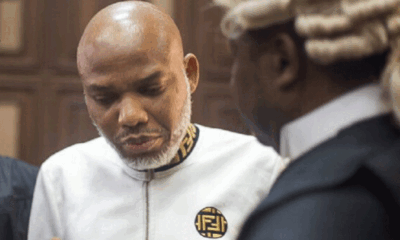

Nnamdi Kanu’s Legal Team Raises Fresh Questions Over Omotosho’s Judgment in Part 3 Commentary
Onyedikachi Ifedi, Esq., has questioned the legal basis of Nnamdi Kanu’s conviction, alleging irregularities involving Count 7....


IPOB Denies Plans to Resume Monday Sit-at-Home, Rejects Alleged Police Intelligence Report
IPOB has dismissed a purported police intelligence report alleging plans to resume Monday sit-at-home enforcement in the South-East...


‘No Negotiations, Only Referendum’ — Kanu’s Message to American Veterans of Igbo Descent
IPOB leader Nnamdi Kanu has reaffirmed his demand for a referendum on Biafra's self-determination, insisting he will reject any political...


IPOB Condemns NYSC Abductions in Imo, Accuses Uzodinma of Political Conspiracy
IPOB has condemned the reported abduction and rescue of NYSC members in Imo State, denying involvement and accusing Governor Hope...


Ambrose Alli University Lecturer Dies in Hotel Room After Sexual Encounter With 21-Year-Old Woman
A senior lecturer at Ambrose Alli University, Ekpoma, Dr Matthew Uwuigbe, has died in a hotel room in Edo State...


Omotosho’s First Jurisdictional Failure — The Court Lacked Authority to Try Kanu
The Mazi Nnamdi Kanu Global Legal Consortium has alleged that the Federal High Court lacked jurisdiction to try Kanu on...


‘No Government Without a Country’: IPOB Rejects Self-Appointed Biafra Government Officers
Mazi Chris Nwaọgụ has reiterated IPOB’s demand for Nnamdi Kanu’s freedom and Biafra’s restoration, while calling for Kanu’s appeal to...


Sokoto Declaration: Emma Powerful Dismantles False Claims, Reaffirms Onyendu Mazi Nnamdi Okwu Kanu’s Referendum Position
Kanu’s camp has rejected claims that he did not approve or co-sign the Sokoto Declaration, while stressing that he does...


Kanu’s Unlawful Conviction, the Law That Was Already Dead, and the Shame That Is Waiting for Nigeria’s Judiciary
Christopher Chidera, Esq., has challenged the legal basis of Nnamdi Kanu’s conviction, arguing that the trial court relied on a...