
Politics
Abacha Died of Cardiac Arrest During Intercourse, Not Poisoned by Apples — Ex-DSS Operative Reveals
A former DSS Assistant Director has claimed in a new memoir that late military ruler General Sani Abacha died of a cardiac arrest during an intimate encounter…

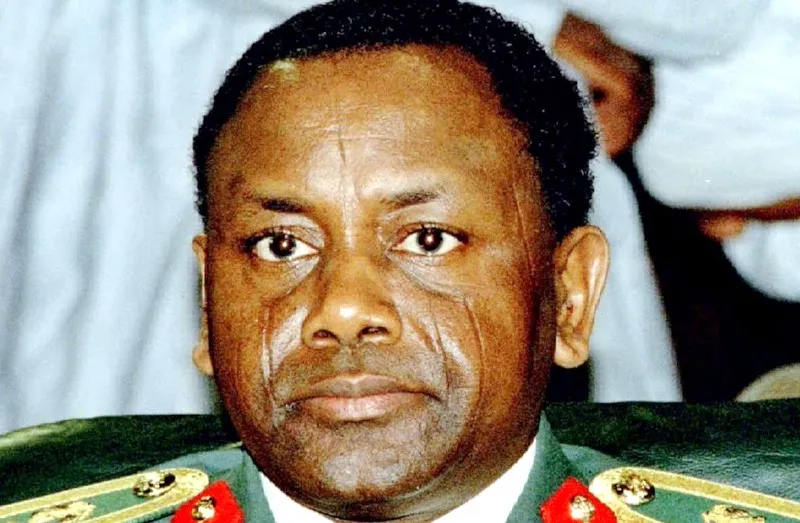
- A former DSS Assistant Director has claimed in a new memoir that late military ruler General Sani Abacha died of a cardiac arrest during an intimate encounter, dismissing long-standing theories that he was poisoned by apples.

A former Assistant Director of the Department of State Services (DSS), Dennis Amachree, has claimed that former military Head of State, late General Sani Abacha, died from a cardiac arrest during an intimate encounter with his girlfriend, dismissing long-standing claims that the former ruler was poisoned.
Amachree made the revelations in his newly released memoir, DSS @40: My Journey Behind the Shield, excerpts of which were published by The Nation on Tuesday.
The retired intelligence officer, who served as Assistant Director of Operations and Intelligence at the Lagos DSS Command when Abacha died in June 1998, said the late military ruler suffered the fatal cardiac arrest at about 4:05 a.m. at the Presidential Villa in Abuja.
According to Amachree, the woman who was with Abacha at the time panicked after discovering he had become unresponsive and left the Presidential Villa before the incident became known to security officials.
He alleged that the woman, described as a pharmacist who was in Abuja for a conference, had accompanied her elder sister, said to have been Abacha’s girlfriend, to Aso Rock earlier that night.
According to the memoir, “At approximately 2.40 am, shortly after Gen. Useni left, Abacha’s girlfriend, an Igbo lady (name withheld), arrived at the Aso Rock Guest House from the Nicon Noga Hilton Hotel.”
“With her was her younger sister, a pharmacist who was in Abuja for a conference. The Head of State had just bought his girlfriend a new SUV, and they decided to stop by to say hello to ‘Oga’.”
Amachree further wrote that “Abacha was taken with the younger sister, and after a short while, the girlfriend returned to the hotel, leaving the pharmacist alone with the Head of State.”
He claimed that during the encounter, the woman realised Abacha was no longer responding.
“At about 4.05 am, as they were getting intimate, the pharmacist realised Abacha had stopped moving. She called out to him, but he was unresponsive and stiff. She checked his pulse; there was none.”
Amachree also alleged that the woman immediately left the villa after requesting transport back to her hotel.
“In a state of panic, she quickly dressed and left the guest house, telling the soldier on guard duty that ‘Oga’ had asked for a car to take her back to her hotel.”
According to him, the woman travelled to Lagos on an early morning flight before security agencies could question her.
He claimed that after Abacha’s Chief Security Officer, Major Hamza Al-Mustapha, was informed of the incident around 5:00 a.m., efforts were made to locate the woman, but she had already left Abuja.
Amachree said the DSS headquarters later directed him to trace and interrogate her in Lagos.
Recalling the encounter, he said the woman repeatedly insisted, “I did not kill him, he died on top of me.”
He added, “My team located and brought her to my office. I interrogated her myself. The first thing she said to me was: ‘I did not kill him, he died on top of me.’ After her detailed account, I called the Director in Abuja, and she was immediately flown back.”
The former DSS operative argued that the woman’s account contradicts many of the conspiracy theories that have surrounded Abacha’s sudden death for nearly three decades.
“The lady pharmacist’s account, on whom Abacha apparently had a coitus-induced cardiac arrest, remains the true position, and puts an end to the conspiracy theories and half-truths that have gone viral,” he wrote.
General Sani Abacha ruled Nigeria from November 1993 until his death on June 8, 1998. His sudden death while in office has remained one of the country’s most debated political events, with numerous conflicting accounts emerging over the years.





BREAKING: Nollywood Actor Francis Duru is Dead, Family Release Statement, Shares Cause of Death
Francis Duru’s family has confirmed his death following a brief illness, as colleagues and fans mourn the veteran Nollywood actor.


One Law for Abba Kyari, No Law for Nnamdi Kanu: Omotosho’s Fourth Jurisdictional Collapse
In Mazi Nnamdi Kanu’s Case, where Kenya was the territorial state, Kenyan sovereignty, comity, and statutory double criminality were utterly...


Ebola in Nigeria: How to Protect Yourself, Symptoms to Watch and Where to Get Help
Following the confirmation of an Ebola case in Abuja, here is essential safety advice for Nigerians, healthcare workers and travellers,...


Ebola: WHO Advises Against Travel, Trade Restrictions After Nigeria Confirms Case
WHO has advised against travel and trade restrictions on Ebola-affected countries as Nigeria monitors 44 contacts following an imported case...


Ebola: Five Things to Know About Bundibugyo Virus as Nigeria Confirms First Case
Nigeria has confirmed an imported Bundibugyo Ebola case in Abuja. Here are five key facts about its symptoms, transmission, treatment...


Italy Rejects 2,220 Nigerians Seeking Asylum
Italy rejected 2,220 Nigerian asylum claims in first-instance decisions in 2025, while 1,175 Nigerians received protection and 4,120 cases remained...


Dangote Buys 25% Stake in Kenya Pipeline Network, Plans $50bn Expansion
Aliko Dangote says his Group has acquired a stake in Kenya’s petroleum pipeline network as it expands fuel distribution infrastructure...


28-Year-Old POS Operator Sentenced to Death by Hanging Over Role in Kidnap Gang
An Imo court has sentenced a 28-year-old POS operator to death over his involvement in the abduction and murder of...


UTME: JAMB Considers Life Skills, Critical Thinking Tests for Admission Seekers
JAMB is considering adding life skills and critical thinking to the UTME, while introducing procedures to help candidates resolve discrepancies...


AAC Writes Tinubu, Demands Aso Rock, Food and Logistics for 5,000 Supporters at Sowore’s Inauguration
The AAC has requested permission to inaugurate Sowore’s presidential campaign council at Aso Rock, asking the Presidency to provide refreshments...