
News
The State Is a Terrorist by Its Own Law — and the Supreme Court Let It Prosecute Its Victim
Legal practitioner Christopher Chidera has raised six alleged legal errors in the Supreme Court’s December 15, 2023 decision ordering the continuation of Nnamdi Kanu’s trial

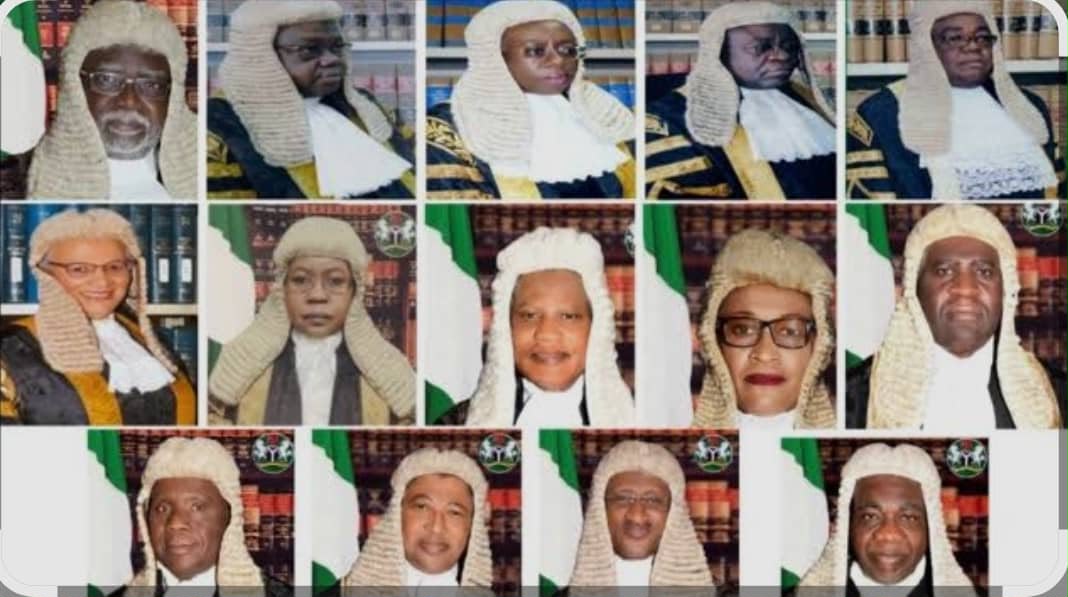
- Legal practitioner Christopher Chidera has raised six alleged legal errors in the Supreme Court’s December 15, 2023 decision ordering the continuation of Nnamdi Kanu’s trial, demanding clarification on the legal basis for the proceedings.

The Supreme Court’s December 15, 2023 decision ordering the continuation of Nnamdi Kanu’s trial has come under fresh scrutiny, with legal practitioner Christopher Chidera alleging that the decision was based on six fundamental legal errors.
In an open letter to the Nigerian Bar Association, Chidera argued that the issues surrounding the Supreme Court’s decision ultimately affected the subsequent trial and conviction of Kanu before Justice James Omotosho of the Federal High Court.
According to him, the first major issue was the Supreme Court’s description of the Terrorism Prevention Act 2013 as “extant and existing law” in December 2023.
Chidera contended that the law had already been repealed on May 12, 2022, by Section 98 of the Terrorism (Prevention and Prohibition) Act 2022.
He cited Section 122 of the Evidence Act, which requires courts to take judicial notice of laws that are currently or were previously in force in Nigeria.
He argued that the court therefore had a duty to recognise the repeal of the 2013 terrorism legislation, just as Justice Lawal Garba had corrected the citation of the Criminal Code from Cap C45 to Cap C38 in the same judgment.
Chidera said the key issue was not whether the 2013 law once existed, but what legal provision kept the proceedings alive after its repeal.
‘Continuation’ or retrial?
The second issue raised concerns the Supreme Court’s use of the word “continuation” rather than “retrial.”
Chidera noted that on October 13, 2022, the Court of Appeal had discharged Kanu, quashed the charges against him and held that the courts had been divested of jurisdiction based on the African Charter Act.
Although the Supreme Court subsequently set aside that judgment, Chidera argued that the decision did not expressly explain the legal status of the quashed charges after the Court of Appeal judgment was overturned.
He maintained that if the original proceedings had legally ended, there had to be a statutory mechanism for bringing them back into existence.
“The Supreme Court had to identify that mechanism,” he argued, adding that the court did not do so in its order for “continuation.”
African Charter question
The third issue identified by Chidera concerns the African Charter on Human and Peoples’ Rights.
He pointed to portions of the Supreme Court’s judgment in which the court recognised the African Charter as part of Nigerian law and stated that Nigerian courts were required to give effect to it.
According to him, the Court of Appeal had relied on the African Charter Act in reaching its decision on Kanu’s unlawful rendition.
Chidera argued that although the Supreme Court overturned the Court of Appeal’s judgment, it did not adequately explain how the legal consequences of the African Charter ceased to apply to the circumstances surrounding Kanu’s transfer from Kenya to Nigeria.
He further argued that the right to seek damages from the government could not, by itself, turn an allegedly unlawful rendition into lawful criminal process.
Supreme Court’s finding on Kanu’s rendition
The fourth issue relates to the Supreme Court’s findings concerning Kanu’s removal from Kenya.
Chidera cited Justice Emmanuel Agim’s findings that Kanu had been kidnapped and abducted and subjected to extraordinary rendition from Kenya to Nigeria.
He said the judgment described the conduct as “prohibited by law,” “brazen lawlessness” and a process that had become “unfair and oppressive.”
Chidera argued that the court’s findings created a legal contradiction because the same proceedings subsequently continued despite those findings.
He also cited Kenyan law, arguing that Kenya’s Penal Code criminalises conveying a person beyond the country’s borders without consent.
The letter further refers to provisions of Nigeria’s Terrorism (Prevention and Prohibition) Act 2022, particularly Section 2(3)(f) and Section 2(3)(g)(ii), which Chidera argues cover treaty violations and kidnapping respectively.
He contended that because the Supreme Court found that Kanu had been kidnapped and subjected to extraordinary rendition, questions arose over whether the conduct fell within those provisions.
The Madukolu jurisdiction question
The fifth alleged error centres on the established principle in Madukolu v Nkemdilim concerning the conditions required for a court to exercise jurisdiction.
Chidera cited the Supreme Court’s own restatement of the principle that a case must come before a court through due process of law and upon fulfilment of any condition precedent to the exercise of jurisdiction.
He argued that this principle raised a fundamental question about the legal basis for the Federal High Court’s continued jurisdiction over Kanu’s case after the Supreme Court had found that he was unlawfully abducted and brought into Nigeria without lawful extradition proceedings.
He also cited Justice Lawal Garba’s statement that jurisdiction cannot be conferred by consent, agreement or acquiescence, and that even the Supreme Court cannot confer jurisdiction where none exists.
Chidera therefore questioned how Justice Omotosho acquired jurisdiction to revive the previously quashed counts.
Section 76 and conduct outside Nigeria
The sixth issue raised in the letter concerns Section 76(1)(d)(iii) of the Terrorism (Prevention and Prohibition) Act 2022.
Chidera argued that the provision creates a jurisdictional requirement in cases involving offences allegedly committed outside Nigeria.
He questioned whether the prosecution had established the necessary legal basis for conduct attributed to Kanu while he was outside Nigeria, particularly in relation to Kenya or Britain.
According to him, a statutory jurisdictional condition cannot simply be replaced by judicial assumption.
‘What law restored the quashed counts?’
Chidera said the central question emerging from the six issues was the legal basis upon which the quashed charges were restored.
He noted that the Court of Appeal discharged Kanu and quashed the charges on October 13, 2022, while the Supreme Court set aside that decision on December 15, 2023.
However, he argued that a critical question remained unanswered: what statutory provision automatically restored the quashed counts?
He similarly questioned what law converted a discharged proceeding into a continuing one, what legal provision converted the alleged unlawful rendition into due process, and what provision permitted the repealed 2013 terrorism law to be described as “extant and existing law.”
Call for legal clarification
The lawyer called on the Nigerian Bar Association, the International Bar Association and other members of the legal profession to examine the issues raised in the case.
He urged the legal community to identify the statutory basis for the restoration of the quashed counts and the jurisdiction exercised by the Federal High Court.
“The issue is not whether Nnamdi Kanu is popular or unpopular,” Chidera said. “It is not whether the State considers him dangerous. It is not whether the allegations against him are serious.”
He argued that the seriousness of terrorism allegations makes adherence to jurisdictional and due-process requirements even more important.
According to him, “a terrorism prosecution does not create a terrorism exception to jurisdiction,” while a Supreme Court order cannot itself become a source of jurisdiction where the law does not provide one.
Chidera concluded by challenging the Nigerian legal profession to identify the specific laws underpinning the continuation of Kanu’s trial and the subsequent conviction.
“Show us the law,” he demanded.






IPOB Condemns NYSC Abductions in Imo, Accuses Uzodinma of Political Conspiracy
IPOB has condemned the reported abduction and rescue of NYSC members in Imo State, denying involvement and accusing Governor Hope...


Ambrose Alli University Lecturer Dies in Hotel Room After Sexual Encounter With 21-Year-Old Woman
A senior lecturer at Ambrose Alli University, Ekpoma, Dr Matthew Uwuigbe, has died in a hotel room in Edo State...


Omotosho’s First Jurisdictional Failure — The Court Lacked Authority to Try Kanu
The Mazi Nnamdi Kanu Global Legal Consortium has alleged that the Federal High Court lacked jurisdiction to try Kanu on...


‘No Government Without a Country’: IPOB Rejects Self-Appointed Biafra Government Officers
Mazi Chris Nwaọgụ has reiterated IPOB’s demand for Nnamdi Kanu’s freedom and Biafra’s restoration, while calling for Kanu’s appeal to...


Sokoto Declaration: Emma Powerful Dismantles False Claims, Reaffirms Onyendu Mazi Nnamdi Okwu Kanu’s Referendum Position
Kanu’s camp has rejected claims that he did not approve or co-sign the Sokoto Declaration, while stressing that he does...


Kanu’s Unlawful Conviction, the Law That Was Already Dead, and the Shame That Is Waiting for Nigeria’s Judiciary
Christopher Chidera, Esq., has challenged the legal basis of Nnamdi Kanu’s conviction, arguing that the trial court relied on a...


Elochukwu Ohagi Describes Nnamdi Kanu as ‘Anointed Builder’ in Biafran Cenotaph Tribute
Elochukwu Ohagi has described Nnamdi Kanu as an “anointed builder” and “divine instrument” in the struggle for Biafran restoration, highlighting...


Delta Commissioner, Three Others Arrested Over Deputy Director’s Death
Five suspects are now in custody, while police have declared two others wanted as investigations into the ministry official’s death...
Kanu Family Fires Back: ‘No Statutory Transition Means No Valid Sentence’
The Okwu-Kanu Family has called for the immediate hearing of Nnamdi Kanu’s appeal, questioning the written law underpinning his conviction...
IPOB Accuses Nigerian Judiciary of ‘Judicial Banditry’ Over Nnamdi Kanu Conviction
IPOB has accused the Nigerian judiciary of violating constitutional provisions in Nnamdi Kanu’s conviction, questioning the legal basis of the...